



We’ll See
Between this year’s IMTS and the MPMA’s Fall Technical Meeting (FTM), I heard a lot of confidence about where manufacturing is headed, and the most sensible response to much of it is still “we’ll see.” Plenty of what was on display at IMTS works, but what hasn’t been shown yet is how well it holds up over years of service.
At IMTS 2024, the conversation was mostly about uncertainty: the election, interest rates, tariffs and whether EV adoption would keep its pace. This year it was about AI and robotics. A large share of the exhibit floor showed automated machine tending, robot integration and software that generates CAM code. Tariffs haven’t settled, but some gear manufacturers have stopped waiting for them to. I heard about several large orders for gear-cutting machines that had been on hold, and at least part of that demand appears to come from robot gear production.

The two big stories of the last few years ask different things of gears. An EV drivetrain uses fewer gears than a conventional transmission, but those gears turn at motor speeds with no engine noise to mask them, so they have to be made to something close to aerospace quality at automotive volumes. A humanoid robot needs many more gears to the same exacting standard. Schaeffler puts the count at 25 to 30 actuators for the major joints alone. Once you add dexterous hands, many with their own miniature gearboxes, a single machine can carry well over a hundred gears: strain wave, planetary, worm and spur, most of them small and all expected to hold position without backlash for years. EV makers have already shown they can build at volume. For humanoids, that is still the open question.
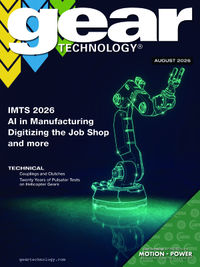
This issue of Gear Technology carries both stories. Felss describes axial cold forming of helical gears directly on EV rotor shafts, displacing material instead of cutting it away, which saves energy and preserves the fiber flow that fatigue strength depends on. Gleason and KISSsoft walk through the design, power skiving and sub-micron inspection of strain wave gears, a part that is simple to sketch but hard to make in the thousands. And Jacques Lemire’s update of the MPMA Emerging Technology Robotics Committee white paper is a useful corrective to the investor headlines. AI has given the humanoid a far better brain, but safety at speed, reliability and cost in the actuator drivetrain still stand between the demo and the customer.
On the AI side, Paul Langlois and his co-authors show a machine-learning optimizer arriving at gear microgeometry comparable to what an experienced engineer produced by hand, in about 30 minutes, then going further to find a microgeometry that holds up across a range of torques. The engineer is still the one deciding what a good result looks like. The software gives back the hours that used to go into hunting for it.
FTM had plenty of the same. In the emerging technology session, Frank Kressel of Reishauer made the case for tying machine, process and inspection data into a single picture of a grinding operation, and Arian Sardari of RWTH Aachen presented a framework pairing physics-informed neural networks with causal models to find the root of an NVH problem instead of cataloging its symptoms. Faisal Ahmed Youssef of MOPCO put large language model (LLM) output up against expert-approved vibration diagnoses, an important test these tools need. Meanwhile, FZG was still pulsator testing coarse-grained case-hardened teeth, and Timken was still refining bearing life predictions, because none of the new work stands up without the foundational work underneath it.
That is what keeps “we’ll see” from turning cynical. Robots and algorithms are real, and some of them will matter a great deal to this industry, but whether they matter on the timeline the keynotes promise depends on gears that are designed, made, measured and tested by people who have been doing it for a long time. We’ll see. I expect much of the answer will show up in future pages of this magazine.