
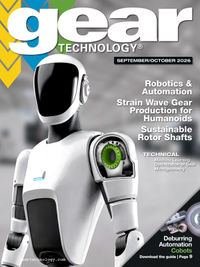
“The time has come for robots,” Nvidia CEO Jensen Huang proclaimed at his company’s annual GPU Technology Conference in March 2026. “Everyone, pay attention. This could very well be the largest industry of all.”


A technical overview of the three principal face couplings (Hirth, Coniflex, and Curvic), comparing their tooth geometries, self-centering behavior, and Gleason’s cutting and grinding processes for manufacturing them.
.
This excerpt from Gear Technology Solutions explains how oversized cutter blade edge radii cause root interference in bevel gears, and how to select correct radii to avoid noise, flank damage, and tooth fracture.
.
This article demonstrates why bevel gears are designed with a zero sum of profile shifts—showing that independent shifts merely replicate what a modified pressure angle already achieves—and explains the practical benefits of using conical generating gears for tooth profile crowning.
.
20NiMo9-7 alloy achieves up to 48 percent higher fatigue strength than conventional carburizing steels in the as-carburized condition, eliminating the need for shot peening and grinding in automotive gear applications.
.
This article describes a cloud-based process and machine component monitoring system called ARGUS. The term “swarm” is used for a large population of gear-grinding machines of individual and independent customers connected to the ARGUS system and the ARGUS cloud. These “swarm” machines permanently feed their anonymized process data into a common cloud database. Reishauer uses this database for big data analytics to discover patterns that indicate successful process and machine component behavior patterns worth integrating into the ARGUS algorithms and propagate them across the complete ARGUS customer base.

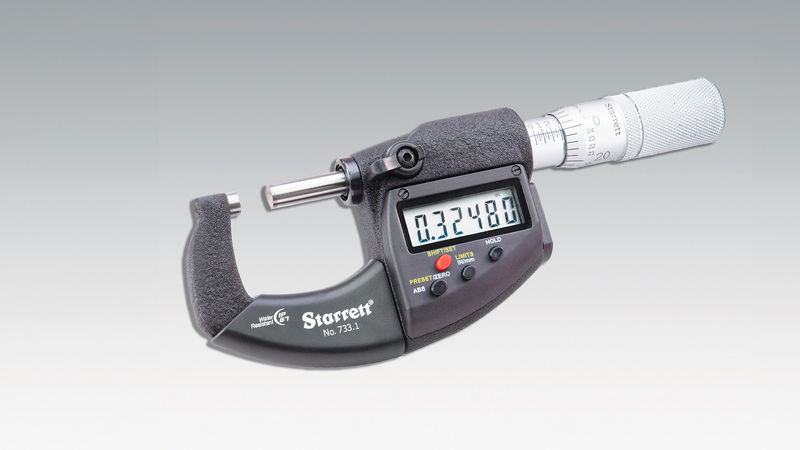
For precision measuring, skilled machinists, toolmakers, and inspectors must have accurate tools and gages, produced from quality materials, carefully manufactured, and rigidly inspected, to ensure lasting dependability. Gages have evolved throughout the years beginning with mechanical, then electronic models, and now convenient wireless electronic versions have come on the scene. Each type has an important place in today’s quality control and inspection processes.

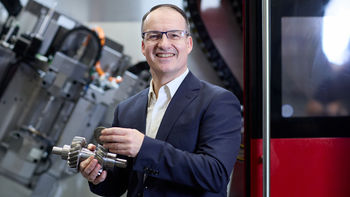
Since I have had the privilege of visiting numerous gear plants and research centers in the U.S., as well as 170 in 33 countries, and I closely watch the progression of technology, I wanted to share my observations about some technological advancements. For the purpose of this article, I will focus on three key areas: Robotics, Machine Tools, and Heat Treating.

Spiroid Gearing delivers precision gearing for advanced mechanical systems, engineered to handle extreme torque and complex motion requirements. With unique right-angle gear solutions, our technology enhances efficiency, reliability, and design flexibility - empowering engineers to push boundaries in aerospace, defense, robotics, and industrial applications where performance and durability are non-negotiable.
The demand for double helical gears in planetary gear systems for engines in the civil aerospace industry is increasing. Innovative grinding processes and state-of-the-art technologies ensure precision, reduced weight, and improved cost efficiency. Learn how KAPP NILES reduced the gap width from 30 mm to 15 mm.

Discover four diagnostic enhancement tools that move RX® endothermic gas atmosphere generator operations from preventative to predictive maintenance. Learn how monitoring dew point by retort, comparing equal flow, tracking tube performance, and measuring outlet temperatures prevent costly failures while ensuring consistent, high-quality carrier gas production.
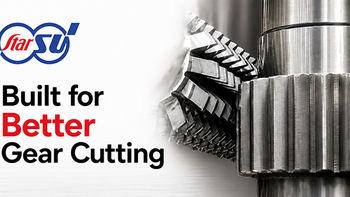
The right hob can make a measurable difference in gear production. Watch the video to see how Star SU combines advanced hob technology with application expertise to help manufacturers get more from every gear cutting operation.

The Intra SFTX twin-spindle single-flank testing system is engineered for advanced gear quality testing and NVH analysis of demanding e-drive gear applications. Combining Transmission Error (TE) and Torsional Acceleration (TA) measurements, it delivers fast, precise diagnostics and detailed order analysis, quickly identifies critical gear issues, enhances traceability, and helps prevent costly defects from reaching end-of-line (EOL) testing.


From adding automation functions to fully automating the whole production line, Mazak can suggest the best solution to solve your labor shortages with technology tailored to each customer's production needs.

New orders of metalworking machinery, measured by the U.S. Manufacturing Technology Orders Report published by AMT (The Association for Manufacturing Technology), totaled $732.9 million in August 2026.

At IMTS 2026 in Chicago, Siemens introduced Meet at the Machine, an initiative in which Siemens and machine tool builders jointly develop machining solutions. Each solution combines Siemens engineering software and automation hardware with the builder's machine. TRAK Machine Tools is the first partner.
Jan 6, 2027 - Jan 9, 2027
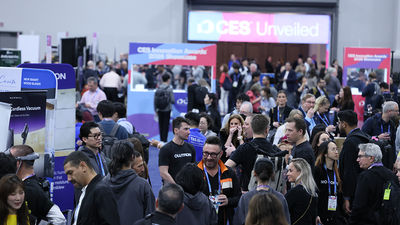
Attracting a diverse range of professionals, including executives, engineers, designers, and entrepreneurs, CES (Las Vegas) is an excellent opportunity to connect, collaborate, and grow your professional network. The broad range of exhibits and industries represented at the show can inspire innovative solutions. Industries include 3D printing, AR/VR/XR, AI, cloud computing/data, construction tech, cybersecurity, robotics, e-Mobility, AI, vehicle tech and more.
Jan 18, 2027 - Jan 21, 2027
Nov 24, 2026 - Nov 26, 2026



Contact | Privacy Policy
©2026 Power Transmission Engineering




Current Issue
Current Issue
Archives
Subscribe
Buyer's Guide
Cutting Tools Gear Blanks & Raw Material Gear Drives Gear Machines Gear Manufacturing Services Gears Grinding Wheels & Abrasive Tools Heat Treating Inspection Equipment Lubricants Machine Tools Resources Services Software Used Machinery Workholding & ToolholdingThe Gear Industry Buyers Guide is your complete directory of suppliers in the gear industry, including great companies like these.
VIEW ALL