

[advertisement]
Industry News

August 3, 2026


Software Manufacturing Machine Tools 5-Axis Machining Grinding Milling Multi-Axis Machining IIoT Industry 4.0 Industry News

Zimmermann Examines the Technologies Changing Machine Tool Construction

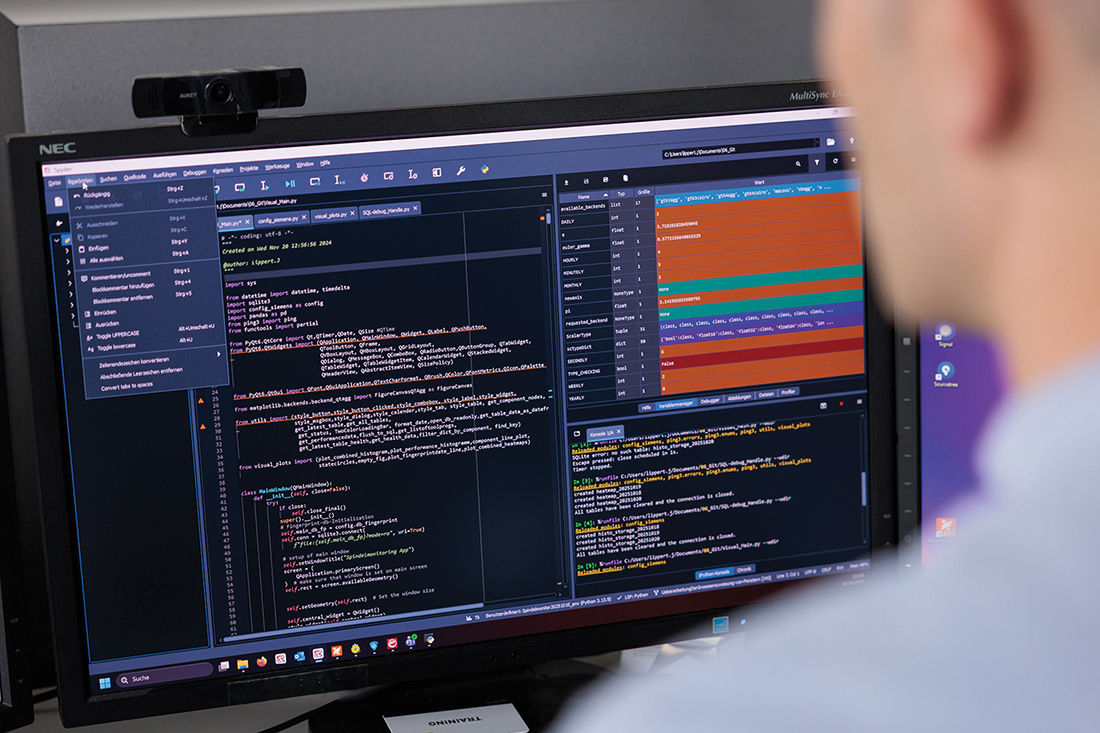
Zimmermann's high-precision portal milling machines are complex digital systems. Control systems, industrial PCs and internal networks must be secured so malware can’t impact them, and adjacent company networks aren’t endangered. Cyber resilience is fast becoming an integral part of modern machine tools. 

Safety features prevent mechanical or electrical risks and ensure that people are not harmed.

“Cybersecurity, on the other hand, affects the entire digital network of a machine,” said Christian Gaarz, head of software development and commissioning at Zimmermann. “All networked components with IP addresses must be secured in such a way that no unauthorized access from the outside is possible. Such an intervention could change processes, cause production to fail and have serious consequences go unnoticed, such as data loss or falsified production parameters. This is particularly critical for components that will later be used in safety-relevant applications such as commercial and military aviation.”

In Gaarz’s role, he and his team are responsible for everything that brings the company’s portal milling machine systems to life digitally: from drives to sensor technology and software solutions. He ensures that mechanical components are turned into a functional, process-reliable overall solution with top-of-mind security in place.

Zimmermann is based in Germany and operates under Managing Director Frieder Ganzle. 

The Cyber Resilience Act (CRA) stipulates how digital products and systems are to be secured. Together with the Machinery Regulation (EU) 2023/1230 and the NIS 2 Directive, a clear European legal framework is being created.

Share and save:


[advertisement]

“For us as a mechanical engineering company, this means that cyber resilience is no longer a voluntary additional service, but a regulatory obligation,” Gaarz said. “We must meet this binding framework for compliance as early as 2027.” 

The requirements already take effect in the development phase of the machines and have a direct impact on design, software architecture and documentation, the company’s key concept being “security by design.” 

This means machine safety aspects are not added retrospectively, they are an integral part of machine development from the very beginning.

Zimmermann systematically prepares for these requirements. The company is represented among various industry specialist working groups and collaborates closely with control manufacturers such as Heidenhain and Siemens, as well as external specialists.

“Especially for a medium-sized mechanical engineering company such as Zimmermann, it is crucial to bundle regulatory know-how to develop practical solutions,” Gaarz said. “At the same time, we are adapting internal processes and training our staff in a very targeted manner.”

The company analyzes which requirements are relevant for the respective machine configuration. Based on this, network architectures are reviewed, segmented and supplemented by suitable security mechanisms. Industrial PCs as well as the main CNC on the machine are secured, software vulnerabilities are assessed with clearly defined processes for updates and documentation.

“We want to minimize digital attack surfaces without impairing the dynamics or precision of the machines,” Gaarz said.

In special machine construction, complexity remains high. Although each system is based on an existing Zimmermann series, it differs in detail such as milling head, peripherals, automation or other specific motion and material handling equipment. Each system is also configured individually. The electrical plan and the respective equipment are used to create a separate topology with several channels, axes, drives and safety functions. Each axis requires precise parameterization. Mechanical differences have a direct effect on the control behavior. Cybersecurity must be integrated into existing structures and must not limit the performance of the machine.

While cyber resilience strengthens security, Zimmermann also wants to further leverage efficiency potential. To this end, the machine manufacturer plans to use digital twins. The virtual environment allows collision checks, parameterizations and software adjustments to be carried out at an early stage. The time for commissioning on the factory floor is reduced, as some of the tests are carried out digitally, in advance. Risks are minimized and processes stabilized. This results in concrete advantages for the customer.

In addition, operators can be trained in advance. In the event of service requirements, fault status can be reproduced in the digital model, so that causes can be identified more quickly. The digital twin supports both machine productivity and process reliability.

[advertisement]

Artificial intelligence (AI) complements this development. Zimmermann is building an internal knowledge database that will be evaluated with the help of AI.

“In pilot projects with control manufacturers, we are investigating how AI can support us in programming or analyzing error messages more quickly,” Gaarz said. “In the future, recurring tasks can be accelerated and proposed solutions generated.”

The technical responsibility remains with the engineer. Zimmermann understands AI is an assistance system whose results must be checked and validated. AI could also be used to create a digital twin more quickly. This also makes it possible to implement the structural development process of a machine more efficiently. 

The guiding principle “Beyond Precision” describes this claim comprehensively, as Zimmermann shows how traditional precision is redefined in a networked industry — as an interplay of mechanics, intelligence and digital responsibility. 

“This development is an expression of technical responsibility,” North American President of Zimmermann Cornelius Kiesel said.

When components are manufactured that will later be used in highly sensitive applications, this concept underlines the importance of holistically conceived precision. With the consistent integration of cyber resilience, simulation and AI, the machine manufacturer said it is strengthening its role as a technology partner for high-precision, large-scale machining and creating the basis for long-term investment security in an increasingly networked industry.

“We see precision not only as a mechanical quality feature, but also as a holistic claim that combines cyber safety, digitalization and engineering expertise,” Kiesel said.

 zimmermann-inc.com


[advertisement]