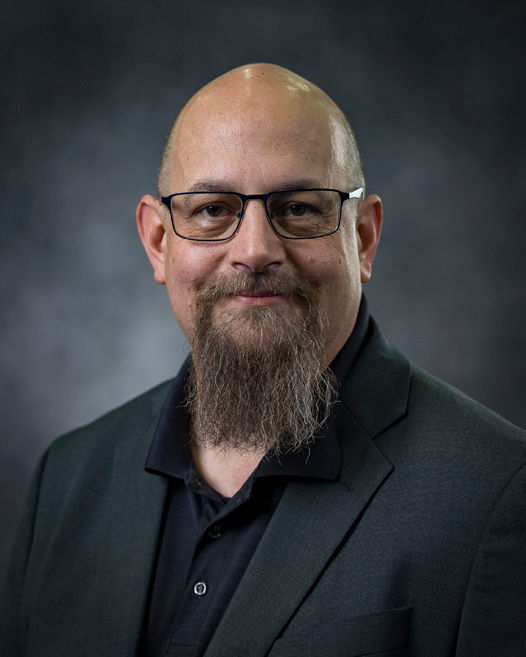
Lance Brown spent 28 years at CGI, Inc.—a Carson City, Nevada-based manufacturer of precision drive systems founded in 1967 and best known for its work in medical robotics and aerospace, now part of The Timken Company—working his way from the shop floor into design engineering and tackling gear problems across some of the most demanding industries in the world. Now, as MPMA’s first Senior Technical Instructor, he’s channeling that experience into a growing education program at a pivotal moment for the organization. We sat down with Brown to talk about the career that got him here, what he’s seeing in the classroom, and where MPMA’s training offerings are headed next.
You spent 28 years at CGI, Inc.—a company that went from a family-owned precision gear house to part of Timken’s industrial motion portfolio. Where did you start, and how did your role evolve?
I started with CGI in early 1997. I learned about the company quite by accident—I wanted to learn how to make gears from a hobby interest, and I also wanted to work for a reputable manufacturer, so CGI checked all the boxes. At the time, I wasn’t even aware they manufactured their own line of industrial planetary gearboxes. Previously, I had worked in job shops where you rarely machine the same parts twice in a row. As my knowledge and experience grew, I moved into the drafting department and finally the design engineering department. I’ve always had an aptitude for gear and gearbox design.
Your career began on the manufacturing floor before moving into design and eventually technical sales leadership. How did that hands-on experience shape the way you approach gear engineering today?
The greatest benefit from my experience on the manufacturing floor was recognizing that it’s common for engineers, especially new ones, to design features on a part, or even an entire part, that couldn’t be suitably produced by the processes available at the time. When reviewing a drawing, we would have to ask ourselves, “How the heck am I going to get a tool in there to create a radius in an internal blind groove?” As a mechanical drafter, it was clear to see how those features could easily be over-designed. So, we would meet with our customer and discuss the issues feature by feature. Today we call this DFM—design for manufacture—and it’s something I stress in all the courses I teach.
CGI has a remarkable footprint in medical robotics, aerospace, and defense. Can you share an application that was particularly challenging or rewarding?
All those sectors provided opportunities to engage in some incredibly diverse design projects. We designed a gearbox to operate just above the sea floor at a depth of 10,000 feet. We designed gears and gearboxes that live in space—in orbit, on the moon, and on Mars. CGI’s catalog products, without any customization, are in every application from pick-and-place machines to machinery that produces siding for residential construction.
But the most rewarding for me was the medical and robotics space. We collaborated with the top engineers in those fields, and I know that CGI continues to do so. One such application is a robotic surgical platform that, quite literally, saved my daughter’s life. I’m not sure how to put a finer point on it after that.
You’ve been active on AGMA’s Technical Division Executive Committee and multiple technical committees. How did that standards work complement what you were doing day to day?
It was wonderful—I miss being involved. It really opened my eyes to the breadth of the gear industry. It was empowering to know that each member company can have an impact on the industry at large, and it was refreshing to see that the technical standards and information sheets were in such good hands. I can’t recommend strongly enough that people get involved with one or more of the committees. There’s a minimal time commitment—about two hours every few weeks—for what I felt was a large return. Specifically, it helped me apply the standards with a deeper understanding of the methodologies contained in them. The opportunity to ask questions of the people directly involved in developing those standards is truly helpful as well.
You could have stayed in industry. What made you want to step into a full-time teaching role with MPMA, and what does it mean to you to be the organization’s first Senior Technical Instructor?
I’m honored to be the first official instructor for MPMA. I’ve been teaching to some degree since I was a teen—it’s in my blood. I truly enjoy sharing knowledge and, where I can, wisdom with others. I’ve had the opportunity to take gear design and gear failure classes with the best there is, including the late Bob Erichello, who was a great influence on me and was so active on AGMA technical committees. I hope to continue their level of excellence, experience, and willingness to share with those who are eager to learn.
You’ve already been teaching the Gear Failure Analysis course. Have there been any moments in the classroom that reminded you why this work matters?
Absolutely. There are failure modes that, based on my personal experience, I would have thought were rare. Yet on separate onsite presentations, I’ve had attendees bring specimens that showed the same failure mode—across multiple product types and industries. That really surprised me.
Another example: my colleague Terry Klaves and I will be in the middle of an example, and attendees from the same company will look at each other—their body language says, “Yep, that is exactly what we’re dealing with.” That opens up the opportunity to take the conversation to the next level and really enhances the experience for everyone in the room.
What do you see as the biggest knowledge gaps facing today’s gear and bearing workforce?
[advertisement]
I’m not sure I’d call it a gap, but there is sometimes a lack of practical experience in our industry—and probably all of manufacturing. Obviously, there’s a ton of emphasis on software for simulation, rating, microgeometry, topological modifications, and so much more. But there’s a real need to actually read through the technical standards and information sheets—not just the formulas, but the cautions. There’s power in programming your own spreadsheet to handle some equations, to understand how they work together, and not just trust the output provided by software. That, in turn, will help you become a real power user of whatever technology you employ for the design or analysis of gears and geared systems.
Lance Brown, MPMA Senior Technical Instructor
Give us a sense of the range of your teaching. What subjects are in your wheelhouse, and what courses are you looking to develop next?
I’ve been blessed with the opportunity to participate in the design and successful application of many different types of geared solutions—spur and helical, worm, bevel, and many simple and compound planetary arrangements. Beyond gears, I’ve designed a number of different mechanisms to support the systems where our gears were critical for success. So, I have a broad range of experience that I’d like to bring to the classroom. In the future, I’d like to develop and offer new courses focused on the robotics and medical sectors, along with the current lineup of MPMA course offerings, which I find to be outstanding.
How would you describe your teaching approach?
I try to be engaging. I’m all too familiar with technical presentations that just seem to drone on and on. I ask questions of the class, I encourage the same from them, and I come to the presentation prepared. I want the class to be fun as well as informative.
Part of your role involves developing new intellectual property for MPMA. What does that look like in practice?
There are areas in our industry where technology is growing and changing the way we think about manufacturing in general, not just gears. While it’s important to knock the dust from your favorite calculator and do the math, it’s also imperative to stay abreast of technology. Modernizing some of the content is one of our focus points.
For readers who may not be familiar, explain what an MPMA onsite training is and how it works.
The process is actually very simple. A phone call or an email to any of the staff at MPMA is all that’s required to get the ball rolling. If the interested party is looking to have a specific class presented to them, we can work with the instructor to determine a date and time before we begin putting a quote together. After a couple of calls or emails, everything is set.
One of the things that sets onsite training apart is customization. How do you tailor a course to a specific company?
The ability to customize a class is very beneficial. Not all content is important to all consumers of the class. For instance, during an on-site tailored presentation of Gear Failure Analysis, the person organizing the class asked me not to “bore the group with involutometry.” They said, “I have broken gears, and I want to know why.” I get it. We can go light on the theory and heavy on the application if that’s what’s needed.
Familiarization with the customer’s parts or gearboxes is always helpful—it’s a conversation that works best ahead of time, but even a tour before the class starts will help any instructor better understand the needs of the attendees. Reviewing drawings is also a great way to accomplish this, assuming they can be shared. Drawings and other documentation really help ensure that we’re all speaking the same language.
“But the most rewarding for me was the medical and robotics space. We collaborated with the top engineers in those fields, and I know that CGI continues to do so. One such application is a robotic surgical platform that, quite literally, saved my daughter’s life. I’m not sure how to put a finer point on it after that.” —Lance Brown
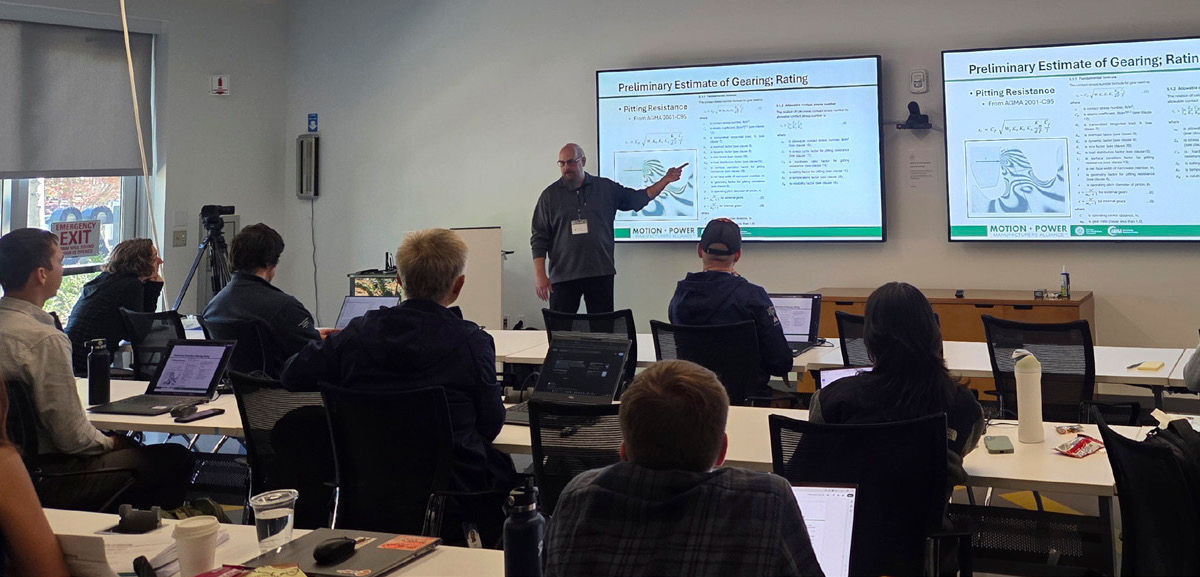
Lance Brown conducting a custom on-site training for a group of robotics engineers.
On-site training can be delivered in person or online. What are the advantages of each?
My personal preference is in-person training. The interaction with the attendees is much more fluid and instrumental in clearing up confusion when the subject matter gets a little deep. The break-time conversations can be really informative, as can the conversations that take place before or after class, when attendees are more open to discussing their examples with an instructor.
Live online instruction would be my second preference. Many times, especially if a company is onboarding new employees, they’d prefer to have them take the training right away rather than wait for a class that may be scheduled months out.
If a company is on the fence about investing in onsite training, what would you tell them?
Well, first, the expense of travel and hotel rooms for a group can be substantial. Terry and I taught an on-site class to 30 people last year. It would have been cost-prohibitive to send a group that size to the national training center. And second, onsite training can be tailored to fit the focus of the company.
You’re stepping into this role at an exciting time—AGMA and ABMA have just merged to form MPMA, education programming has doubled in size, and the industry’s appetite for technical training is growing. What’s your vision for where MPMA education can go from here?
This is an exciting time. Our goal is to improve and increase our offerings and reach as many people as we can. We are working with existing and potential future instructors to flesh out new courses while at the same time modernizing our current courses. A big part of that is letting people know what we have to offer in education—in addition to all the other benefits of MPMA membership.
For more information about MPMA’s education programs, including on-site training options, visit motionpower.org or reach out to education@motionpower.org.