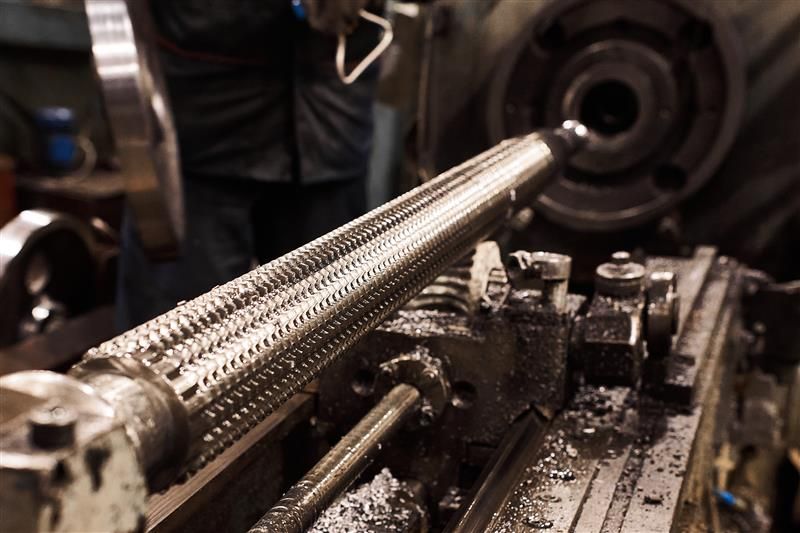
Some designs combine all of these strategies—front round teeth for initial bore sizing, followed by alternating spline and round teeth in the finishing section—to achieve the highest possible concentricity.
Tool Materials and Coatings
The choice of tool material has a direct and measurable effect on broach life, especially as workpiece hardness increases or as manufacturers push for higher cutting speeds.
Conventional high-speed steel (HSS), such as SKH55 (equivalent to AISI M35), has long been the standard broach material. It offers a good balance of toughness and wear resistance for general-purpose applications on carbon and alloy steels within the typical broaching hardness range.
Powder metallurgy (PM) high-speed steels represent a significant step up. PM grades offer finer, more uniform carbide distribution, which translates to better wear resistance and edge retention. Within PM grades, there is a range of options: some are optimized for general high-wear applications, while others are formulated specifically for difficult-to-machine materials like nickel-based superalloys found in aerospace turbine components.
On the coatings side, the industry has moved well beyond basic nitriding. Physical vapor deposition (PVD) coatings, particularly aluminum-based nano-structured formulations, can dramatically extend tool life. Advanced PVD coatings can double the number of parts produced between resharpenings compared to conventional titanium nitride (TiN) coatings, while also improving the surface finish of the broached workpiece by reducing tooth surface roughness to extremely low levels (on the order of Ra 0.03 µm). This smoother tooth surface also reduces flaking on the finished part—a meaningful quality improvement for gear and spline applications.
Workpiece Hardness and Cutting Speed
Getting the best results from a broach requires matching process parameters to the workpiece material.
The ideal workpiece hardness range for broaching is generally HB 200 to 230 (approximately HRC 14 to 21), though materials up to about HB 300 (HRC 32) are commonly broached without issue. Material that is too soft can cause adhesion on the tooth flanks and lands, resulting in poor surface finish with tearing or flaking. Material that is too hard will accelerate broach wear and shorten tool life.
Cutting speed is another critical variable, influencing both dimensional accuracy and tool longevity. Recommended speeds vary by workpiece material—ferrous alloys, cast irons, and non-ferrous metals each have their own optimal ranges. Staying within the recommended speed window for a given material is one of the simplest ways to maximize broach life and part quality.
Resharpening: Protecting Your Investment
Broach tools represent a significant capital investment, and proper resharpening is essential to getting the most out of that investment. Knowing when to resharpen—and doing it correctly—can mean the difference between consistent, high-quality parts and costly scrap.
Signs that resharpening is needed include a visible whitish wear land on the cutting edges, abnormal wear or chipping, chips packing into the gullets, undersized parts (the go-gauge no longer passes), degraded surface finish, excessive heat at the end of the stroke, or abnormally high cutting forces on the broaching machine.
Best practices for resharpening start with preparation. Remove any material adhered to the cutting faces, check and correct any warpage in the tool, and mount the broach securely in the sharpening machine. Use a sharp CBN grinding wheel—as large a diameter as practical—and dress it regularly. Grind the same amount from each tooth to uniformly remove the worn zone. For internal broaches, pay careful attention to the grinding wheel angle relative to the broach to avoid interference between the wheel and adjacent teeth. The correct wheel angle depends on the relationship between the broach diameter, the wheel diameter, and the cutting edge rake angle.
After resharpening, verify that all wear and chipping have been completely removed, that there are no grinding burns, that the resharpened surface finish is Ra 3.2 µm or better, that the tool has been degaussed, and that the gullet surfaces are smooth and free of irregularities that could impede chip flow.
Troubleshooting Eccentricity in Internal Broaching
One of the most common quality problems in internal broaching is eccentricity—the broached feature is not concentric with the pilot hole. This occurs because the broach, supported only by the pulling mechanism during cutting, can be pushed off-center by unbalanced cutting forces.
The symptoms show up in several ways: unprocessed material remaining when the outer diameter is subsequently turned, a go-gauge that won't pass, improperly formed tooth profiles, excessive variation in between-pin measurements, or partial uncut surfaces on the minor diameter.
Diagnosing the root cause requires a systematic approach. A straightforward first step is to mark both the workpiece and the broach so their angular positions are tracked, then broach several parts while rotating the broach mounting position in 90-degree increments. If the direction of maximum runout follows the workpiece orientation, the machine is the likely culprit. If it tracks with the broach position, the broach itself is suspect. If the eccentric direction varies randomly, the workpiece is the most probable source.
Machine-related causes include an out-of-level faceplate (on vertical machines), misalignment between the puller and the travel axis, worn or damaged slides, excessive clearance, or uneven coolant flushing that creates asymmetric forces on the broach.
Broach-related causes include uneven wear or chipping around the circumference of the tooth tips, inconsistencies in chip pocket geometry (often introduced during resharpening), or a bent tool. Runout can be checked by measuring the tooth tip diameter at several circumferential positions along the length of the tool using a dial indicator referenced to the center holes.
Workpiece-related causes include poor roundness, cylindricity, or perpendicularity of the pilot hole, excessive clearance between the broach's front guide and the pilot bore (ideally within 0.03 mm), or uneven material hardness across the cross-section of the part.
The Role of Broaching in Modern Gear Manufacturing
Even as processes like power skiving continue to gain ground, broaching holds a critical position in gear and drivetrain manufacturing. Its unmatched ability to produce complex internal profiles in a single, highly repeatable stroke makes it indispensable for high-volume production of splined hubs, synchronizer rings, planetary carriers, and countless other components. Advances in tool materials, coatings, and broach design continue to expand the process's capabilities, enabling faster cycle times, tighter tolerances, and a wider range of workpiece materials.
For manufacturers looking to optimize their broaching operations, the fundamentals remain the same: start with the right tool design and material for the application, maintain proper cutting parameters, resharpen on schedule and to specification, and approach quality issues with a systematic diagnostic mindset.
Resource credit: Technical reference material courtesy of Nidec Machine Tool Corporation (nidec.com/en/machine-tool/).