


Gear Forging Round-Up 2026
Forged gears beat cut gears because of grain flow. Machining a gear from bar or plate cuts through the material's fiber structure right at the tooth flanks, where bending fatigue does its damage. A near-net or net-forged tooth keeps that fiber running along the profile, which reinforces the root fillet and the tooth's beam strength.
The test data backs this up. Near-net and net-forged straight bevel gears show roughly six to ten times the impact and fatigue resistance of cut gears, and forging can add about 20 percent to fatigue life. Part of that comes from grain alignment; part comes from the lack of machining-induced porosity. Both push crack initiation out to a higher cycle count.
Warm Forging
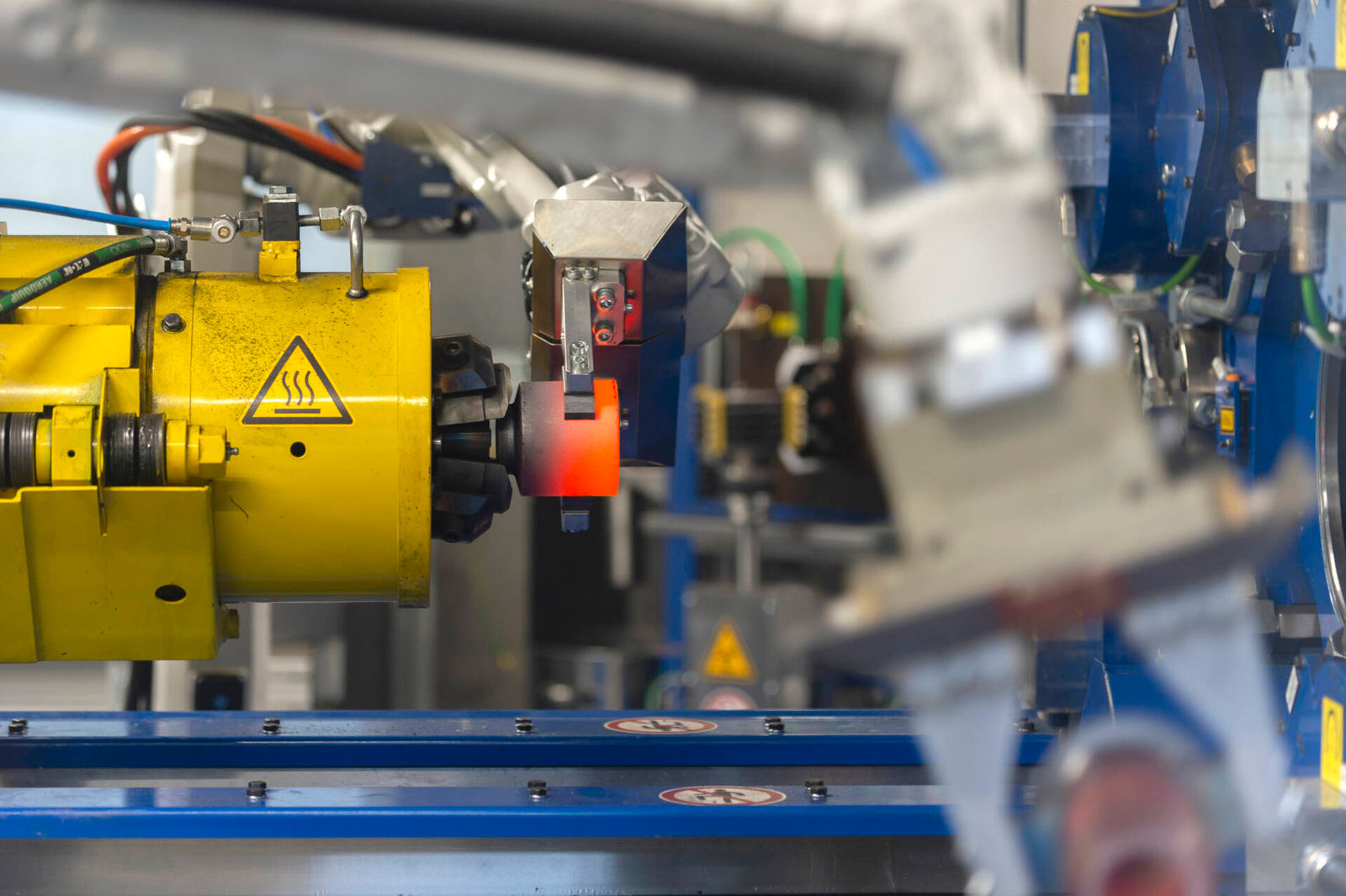
Each forging temperature involves a trade-off. Hot forging fills complex die cavities well but needs heavy machining stock and holds looser tolerances. Cold forging holds tight tolerances but fights high forming loads and limited formability. Warm forging of spiral bevel and helical gears runs in the 873 to 1073 K range (about 600 to 800 °C, or 1,110 to 1,470 °F). It lowers flow stress compared with cold work, holds better dimensional accuracy and surface finish than hot work, and produces a flashless near-net shape that cuts finish machining.
The hard part is filling the tooth lead on a helical gear. Producers handle it with floating-die actions, multi-axis pressing, and FEA preform optimization that sorts out material distribution before the finishing blow.
The clearest sign of where the market is headed came this spring. Linamar acquired Winning BLW's Remscheid and Penzberg plants in Germany, announced March 27 and closed April 30, adding about CAD 200 million in annual revenue. Remscheid runs high-volume precision bevel and intermediate gears for light vehicles. Penzberg makes helical gears and high-precision parts for commercial and off-highway drivetrains.
The deal gives Linamar warm forging for the first time, on top of heat-treat capability it already had. That combination of forging, controlled heat treat, and precision finishing is what bevel and helical drivetrain gears need to hit their hardness, wear, and fatigue targets.
Rings, Testing, and Additive
The rest of the sector keeps moving on the fundamentals. Seamless rolled ring producers still rely on circumferential grain flow and axial-roller height control to deliver near-net gear blanks at tight concentricity, which trims finish machining. McInnes Rolled Rings adopted the KingScan V for faster, more accurate hardness mapping, a reminder that verification often drives lead time as much as forming does. Scot Forge continues its work in additive and hybrid manufacturing and had representation at AMUG 2026.
The Market Backdrop
Metal forging was worth about USD 85.9 billion in 2025 and is on track for USD 93.8 billion in 2026, a 7.8 percent annual growth rate that points toward USD 158.8 billion by 2033. The Casting and Forging Technology Roadmap is due out this spring and should give the industry a shared, data-driven plan for the next decade.
Sources
- Warm forging near-net forming for spiral bevel gears – MDPI
- Forging Ahead for Gear Applications – Gear Solutions
- Seamless rolled ring forging – IQS Directory
- Linamar to acquire Winning BLW facilities – GlobeNewswire
- Linamar completes acquisition – GlobeNewswire
- McInnes KingScan V case study – King Tester
- Forging Market Analysis 2026–2033 – openPR