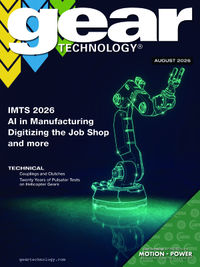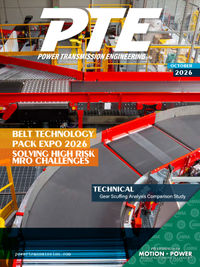
As I write this, I am surrounded by boxes, about to head out across the country with my wife Camilla and our two dogs Zeus and Bob Fosse. Packing a home for a move like this turns out to be a fair way to think about an industry deciding what to carry forward, especially as a lot of companies are having discussions about what to pack, old and new alike, and display at IMTS this September in Chicago.
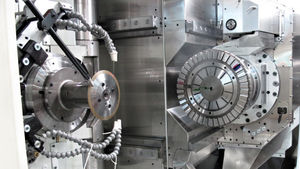
A technical overview of the three principal face couplings (Hirth, Coniflex, and Curvic), comparing their tooth geometries, self-centering behavior, and Gleason’s cutting and grinding processes for manufacturing them.
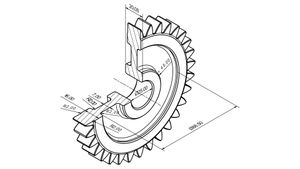
Leonardo Helicopters’ 20-year, 650+ test campaign characterizing tooth-root bending fatigue strength across gear materials, heat treatments, and finishing processes (notably shot peening and superfinishing) to support aerospace gear design.
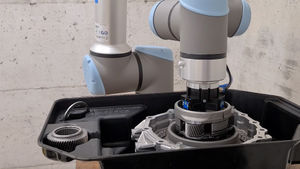
Conversations on the role Physical AI will play on shop floors across manufacturing took place at every stop I made during the Automate Show in Chicago. Robots—in addition to literally doing the heavy lifting—are now being asked to independently learn from experiences and discover solutions without the assistance of human programmers. At the Universal Robots (Teradyne Robotics) booth, I was treated to some amazing force sensing applications that led to a discussion on a recent gearbox assembly use case between AICA (a partner of UR) and Schaeffler that tapped robots to assemble gearboxes.
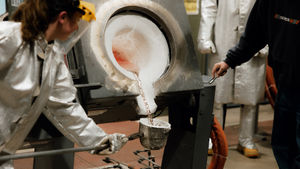
Many students and job seekers are unfamiliar with the advanced technologies and career opportunities available in metal casting and forging. But thanks to the Metallurgical Engineering Trades Apprenticeship and Learning (METAL) program, led by the IACMI-The Composites Institute, that is changing. METAL is partnering with universities to showcase the rewarding careers these industries offer. Together, these institutions are hoping to revitalize American manufacturing by delivering responsive, scalable, and sustainable workforce development programs.
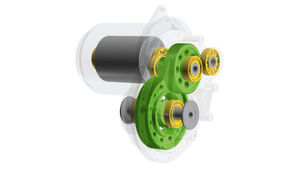
Manufacturing follows the design stage. Many design engineers assume that this step requires little attention. However, this can lead to problems, additional costs, or delays later. Figure 1 shows an example of a typical two-stage EV drive. The idler shaft has two gears, and the original idea was to manufacture it as a single piece. However, the pinion of the second stage is very close to the gear of the first stage. Hobbing teeth on the pinion in this position is not possible. Power skiving may also be unsuitable because optimal process parameters might not be achievable. One possible solution is to mount the gear after the pre-finishing step. Because of precision and noise requirements, the finishing step should be performed with the gear mounted. The same challenge arises for applying honing processes, as there is very little space available.

Through a technology partnership that breaks new ground in the machine tool industry, Siemens presents an automation solution for the busy, multitasking, small to mid-sized machine shop, as it combines a digital twin of the software and programming of its popular Sinumerik 828 CNC, working in tandem with a Kuka robot, to simplify the operation and programming in part handling for the machine tool operator. Bringing the concept to life during a recent tradeshow, Kuka Robotics Corporation demonstrated the same control and its robot working in tandem with a Syil vertical milling machine. The machine featured the Syil R1 machine-tending automation package, developed with one of Kuka’s system partners, Waybo, which seamlessly integrates the pick-and-place, part articulation, and communications with the CNC onboard, all at a very attractive price point.

A common question that MPMA’s technical committees face is whether to adopt an ISO standard or to maintain a separate American National Standard (ANS) on the same subject. The answer is rarely straightforward—it depends on the specifics of each case. Some questions to ask include:
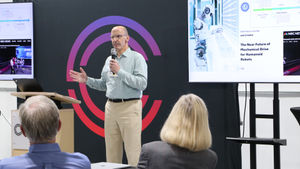
Something new is happening at the 2026 Fall Technical Meeting, and it’s been years in the making. This October in Rosemont, IL, the FTM introduces a second track of presentation-only sessions on emerging technologies, innovative solutions, and real-world applications. For those of us working inside the MPMA Emerging Technology committees, this feels like a natural arrival.
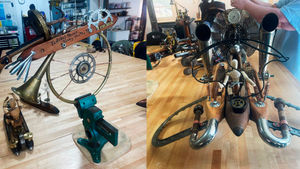
Bruce Rosenbaum, reimagineer and owner of ModVic, LLC, said the air at Snow Farm, the New England Craft Program located in Williamsburg, MA, is usually filled with the scent of sawdust or the glow of a kiln. but recently, it hummed with a different kind of energy—mechanical, historical and re-imaginative. Under Rosenbaum’s guidance, a group of 10 skilled artists and makers showed that when it comes to art, they certainly know how to ‘shuttle’ in a new era of creativity.
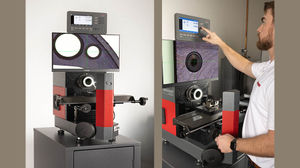
L.S. Starrett Co. launched the HDV250. This next-generation digital comparator is engineered to deliver superior surface illumination, clearer image quality and enhanced measurement accuracy for manufacturing environments.
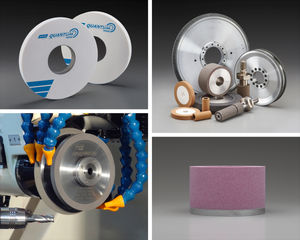
Saint-Gobain Abrasives will showcase a broad range of advanced abrasive grinding technologies and high-performance solutions for gear grinding and other applications at IMTS 2026, Booth #N-237042 located in the Abrasive Machining/Sawing/Finishing Sector, North Building.
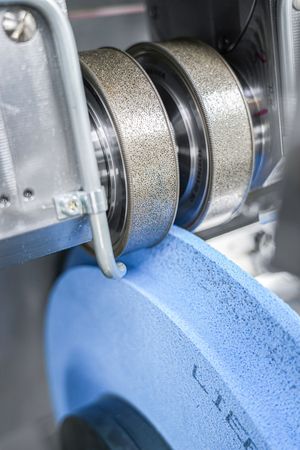
Liebherr will offer a variety of machining capabilities at IMTS 2026 including the LGP 2000 profile grinding machine, the PHS 3000 Allround pallet handling system, and advancements in waviness analysis that enables precise evaluation of noise generation in gearboxes.
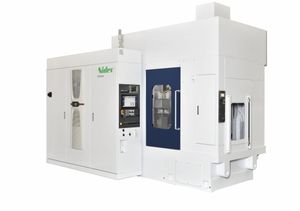
Nidec Machine Tool America will exhibit gear manufacturing and inspection technologies at IMTS 2026. Located in the North Building, Level 3, Booth #237054, the company will feature the newly released RoboCam inspection solution, the ZFA260 gear grinder, and the MSS300 Super Skiving machine.
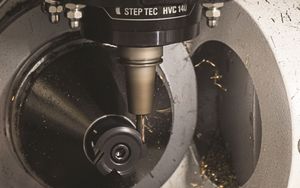
United Machining Solutions will showcase 17 CNC machines featuring the latest innovations from Mägerle, Blohm, Studer, Walter, Agie Charmilles, Charmilles, Mikron Mill and STEP TEC, as well as several new and noteworthy automation accompaniments, including the new Automated Tool Production cell from Walter, the WorkPartner 1 cell from system 3r, and the versaLoad cell from United Grinding North America.

Helios Gear Products will exhibit the NEOPS 100 CNC combination power skiving and hobbing machine at IMTS. Built to meet the production demands of the robotics industry, the machine is also suited to a broad range of internal and external gear work.
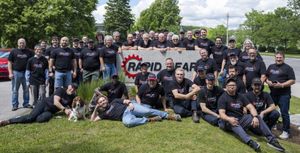
Rapid Gear, based in Kitchener, Ontario, marked its 50th anniversary with a company picnic attended by employees and Kitchener Mayor Berry Vrbanovic.

Gleason Corporation has appointed Bijal Thakkar as President and Chief Operating Officer, effective July 6, 2026. With Bijal Thakkar’s appointment, Gleason reinforces its commitment to long-term growth while remaining focused on delivering innovative solutions that help customers succeed in an increasingly dynamic global marketplace.



Contact | Privacy Policy
©2026 Power Transmission Engineering