A DoW-funded partnership brings online courses and hands-on bootcamps to Purdue’s foundry lab, training that feeds gear production
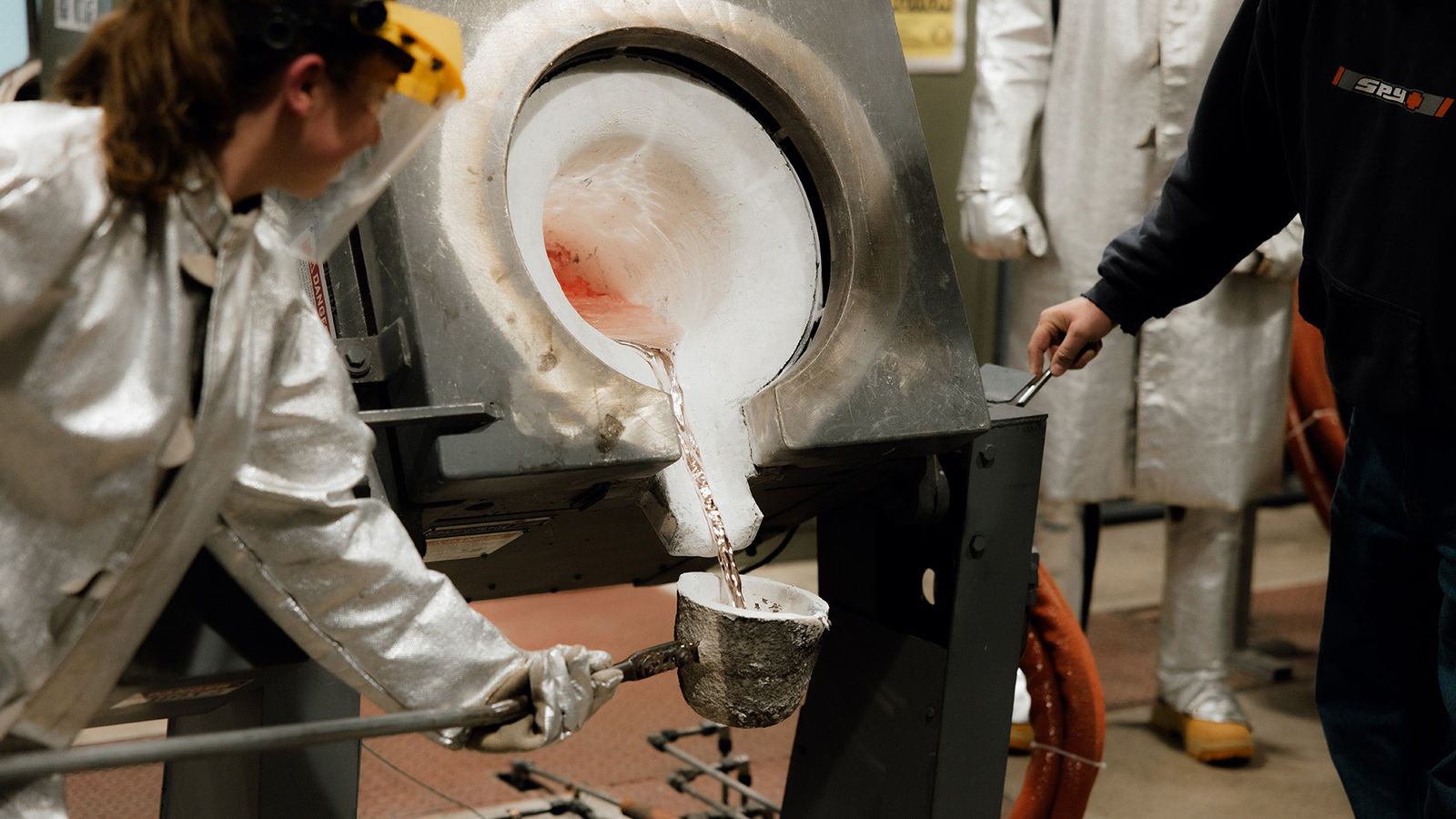
A participant pours molten metal during a METAL bootcamp, gaining hands-on foundry experience alongside instructors. (All images: Rosie Marketing)
Many students and job seekers are unfamiliar with the advanced technologies and career opportunities available in metal casting and forging. But thanks to the Metallurgical Engineering Trades Apprenticeship and Learning (METAL) program, led by the IACMI-The Composites Institute, that is changing. METAL is partnering with universities to showcase the rewarding careers these industries offer. Together, these institutions are hoping to revitalize American manufacturing by delivering responsive, scalable, and sustainable workforce development programs.
“We are helping the workforce be more skilled and talented in the right areas,” said Mike Kubacki, program manager at IACMI.
One of METAL’s newest partnerships is with Purdue University, where engineering programs will expand industry-driven training opportunities for current and prospective metalworking and manufacturing professionals. Funded by the Department of War’s Industrial Base Analysis and Sustainment Program, the initiative focuses on casting, forging and plate rolling.
“Casting and forging is another industry that’s really suffering and needs some help in the workforce development world,” said Kubacki.
Purdue’s School of Materials Engineering within the College of Engineering (https://polytechnic.purdue.edu/academic-areas/soet) within the Polytechnic Institute will implement METAL’s curriculum in its program, beginning with a combination of online training and immersive in-person bootcamps held at a manufacturing lab equipped for metal melting, heat treatment and machining capabilities. The training is free to participants.
“It’s being a long-standing partner in other areas, and it’s a big win overall,” Kubacki said. “They have such great facilities and really engaged professors in this, mission-minded like we are, so I think this is going to yield great results.”
The METAL program will leverage Purdue’s integrated Smart Foundry, embedding Industry 4.0 capabilities such as digital twins, advanced sensing, data analytics, robotics and AI directly into the foundry environment. This positions Purdue as a living laboratory where metal casting expertise and next-generation digital manufacturing technologies come together to advance productivity, sustainability and workforce readiness.
The online curriculum introduces participants to topics including heat treatment, sand casting, forging and tensile strength, which Kubacki described as level one, basic curriculum. “You can take the online curriculum, learn broadly, not too deep, into every little topic,” he said.
The coursework is designed for both newcomers and experienced workers looking to better understand other parts of the manufacturing process. “If you’re in gear manufacturing and you are a CNC machinist, it might be helpful just to take the online curriculum and go learn a little bit about casting and forging, to understand the process before the one you’re doing,” he said. “That can be beneficial.”
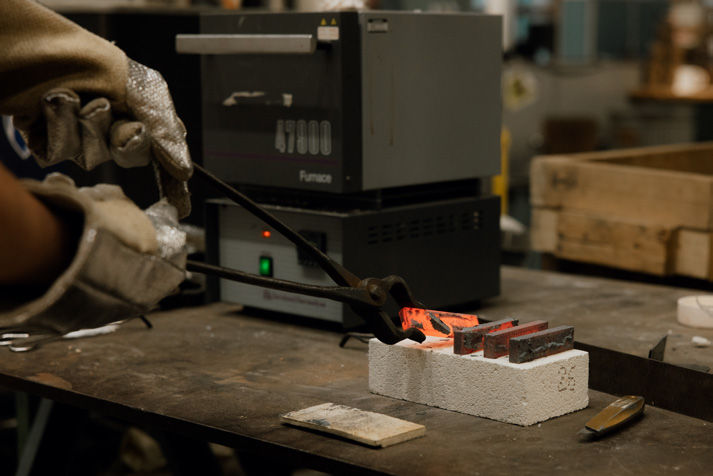
A heat-treated steel bar comes out of the furnace during a METAL bootcamp session—one of the core topics covered in both the online curriculum and hands-on training.
An entry-level operator just coming in off the ground floor could use the online class for onboarding and then go to boot camp to get a base knowledge and train them further. While the online course isn’t a prerequisite to taking the boot camp, Kubacki said it is recommended to make the lesson a bit easier and move faster.
The boot camps allow participants to experience manufacturing firsthand by pouring their own metal and producing cast parts. “They can make a mug out of lost foam casting, which is related to engine blocks that are often made from lost foam casting,” Kubacki said. Participants also create sand molds, pack sand, and explore newer manufacturing technologies such as 3D-printed sand molds.
Purdue’s facilities also expose participants to more specialized manufacturing equipment, including a Bridgman furnace used to produce jet engine turbine blades through investment casting. The university is also utilizing its smart foundry, and they’re creating a boot camp around that to get students to connect to Industry 4.0. “We’re looking at what data is being collected in a foundry,” he said. “How can you analyze that data? How can you better fit your company up for success in the long term?”
Purdue’s program is one version of a curriculum shared across METAL’s university partners. Each university adapts the curriculum to its own facilities and areas of expertise while following the same core model. Whether students attend Purdue, Penn State, or Ohio State, Kubacki said they will receive a comparable training experience centered on six core activities, with each campus adding specialized experiences based on its strengths. “Our role really is focused on network workforce development for the manufacturing processes,” he said. “And that makes gear production possible. Gear manufacturing does depend on advanced materials, forming, machining, heat treatment, inspections, and most of all, skilled people.”
Purdue’s addition to the METAL network strengthens a growing national network of METAL hubs, including the University of Alabama at Birmingham, The Ohio State University, Pennsylvania State University, the University of Tennessee, Knoxville, Tennessee Tech, Michigan Technological University, California State Polytechnic University, Pomona and NC State. As demand for training grows, METAL hopes to expand its boot camp model across the country. “We want to be able to have the boot camps hosted everywhere,” he said.
While Purdue focuses on training students and workers, METAL is also expanding industry engagement and recruitment efforts nationwide. IACMI continues to work with industry partners to participate in boot camps and potentially use those events as a recruitment tool. IACMI has a metal advisory network within the industry that provides support and feedback on curriculum, among other things.
[advertisement]
The organization has also started using virtual reality (VR) to introduce students to manufacturing careers. Through VR headsets, participants can tour industrial facilities and gain a better understanding of modern manufacturing environments. METAL will showcase that technology at the International Manufacturing Technology Show (IMTS) in Chicago this September. “One of those films is from McInnes Rolled Rings in Erie, Pennsylvania,” Kubacki said. “They make rolled rings. That’s a foundation for a lot of gears and bearing applications. Students can take a tour and understand what it would look like to be working in that factory.”
This initiative is one of several new outreach efforts aimed at increasing awareness of careers in metal manufacturing. Beyond its partnership with Purdue, METAL is working with the Foundry Educational Foundation to introduce its curriculum in about 100 high schools. Students can participate in a two-week course that includes hands-on sandcasting activities designed to introduce manufacturing concepts at an early age. The program focuses on regions with strong manufacturing industries, including Pennsylvania, Ohio, Wisconsin, Michigan and Indiana.
With a shortage of workers within many industries, METAL, along with its other partners, is trying to get creative in recruitment. “We have K through 12 goals that we’re trying to hit,” he said. “We want to build that pipeline.” They reach big audiences through STEAM events or a tradeshow, like IMTS. They also host smaller workshops where they bring the students to them to get more in-depth in key areas.
Those outreach efforts come as manufacturers across the country continue to face a shortage of skilled workers. “Our goal is to help the industry in the next six to 12 months,” he said. “We’re trying to get people trained, trying to get them just to understand that the industry needs help, and you can have a great, rewarding career.”