
[advertisement]
Feature Articles

August 14, 2026


Matthew Jaster


Features

Perceive, Understand & Perform

AICA and Schaeffler demonstrate the role Physical AI can play in the manufacturing environment

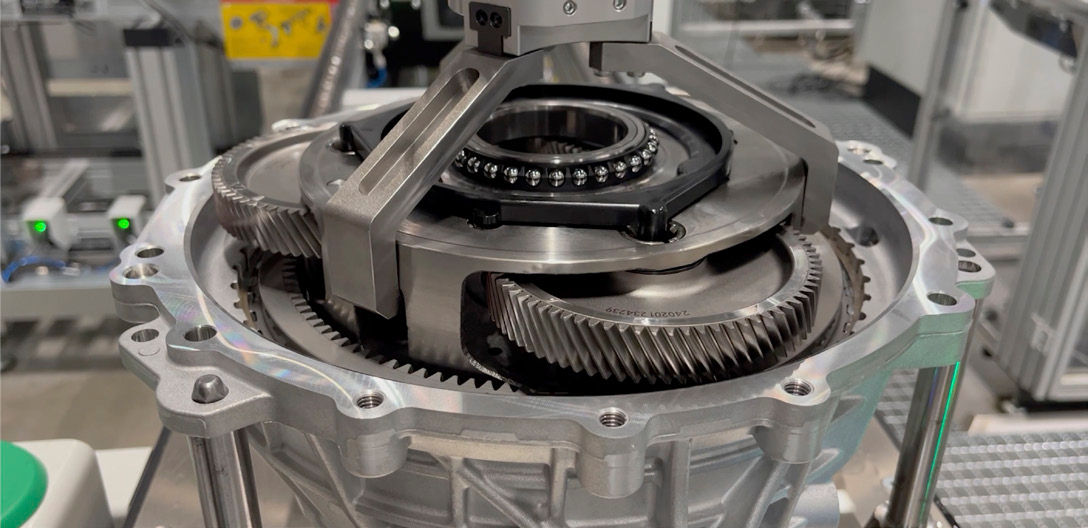
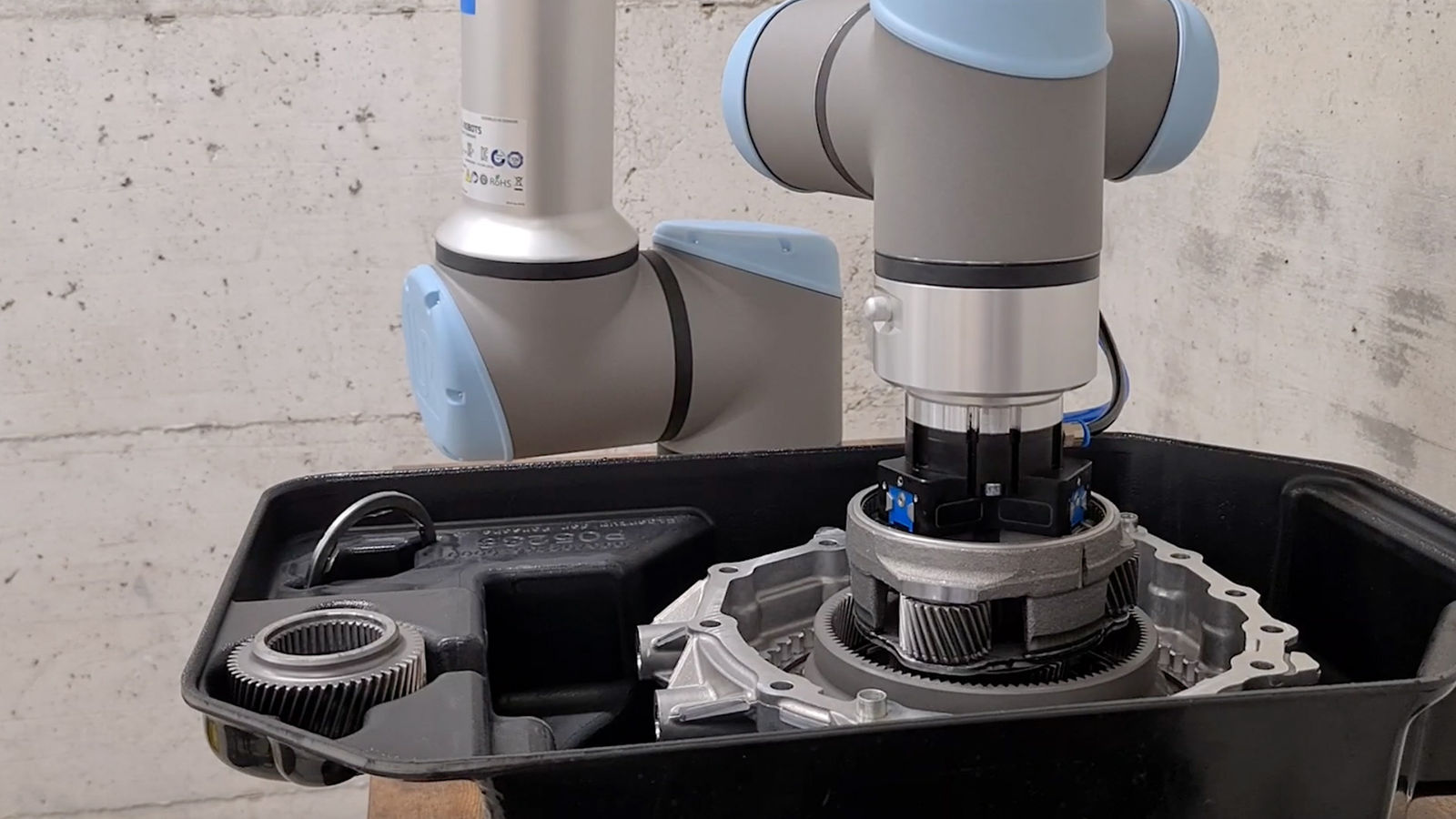
The software was developed and adapted to work within Schaeffler’s specific gearbox assembly process. (All images: AICA)

Conversations on the role Physical AI will play on shop floors across manufacturing took place at every stop I made during the Automate Show in Chicago. Robots—in addition to literally doing the heavy lifting—are now being asked to independently learn from experiences and discover solutions without the assistance of human programmers. At the Universal Robots (Teradyne Robotics) booth, I was treated to some amazing force sensing applications that led to a discussion on a recent gearbox assembly use case between AICA (a partner of UR) and Schaeffler that tapped robots to assemble gearboxes.

Schaeffler faced a variety of unique challenges in design and lifecycle for EVs at a time when the skilled labor force was shrinking. These challenges came to a head during the assembly of planetary gearboxes for an automotive axle. This assembly process exposed the limits of legacy automation: meshing toothed components that rotate independently and vary in tolerance. Conventional programming proved too rigid to adapt, driving up engineering costs and creating production bottlenecks.

The end game was to improve the efficiency and accuracy of their gearbox assembly process. This proved tricky because the parts—like planetary gears—moved freely and unpredictably. This made it hard to program the robots to work effectively. To make things even more complicated, the weight, size, and shape of the parts changed, which slowed everything down. Schaeffler also wanted to be able to switch between different robot brands without a lot of hassle.

Schaeffler sought a solution that could eliminate the dependency on manual labor, handle complex insertion trajectories without rigid, expensive coding, adapt quickly to batch and design changes and scale globally across different robot brands and regions.

These needs led to a partnership with AICA, a Swiss robotics software company specializing in AI-driven automation.

Share and save:


This article appeared in the August 2026 issue.


Read PDF

[advertisement]

AICA’s Smart Assembly module allowed Schaeffler’s robots to adapt their movements between different batches in just one hour. The Smart Assembly application was developed with simplicity in mind allowing users to program both collaborative and industrial robots in three easy steps.

International Rollout

The International Federation of Robotics (IFR) reported that as part of the development cooperation between Schaeffler and AICA, AICA tailored its state-of-the-art robot software to Schaeffler’s specific requirements and use cases. Smart Assembly used real-time adaption, force feedback and autonomous learning capabilities (reinforcement learning) to optimize the assembly process. As a result, the robot independently and autonomously trained the optimum assembly parameters based on previously defined framework conditions and success criteria.

As part of Schaeffler’s industrialization efforts to transfer the AI-empowered automation solution from AICA into series production, a use case in the field of e-Mobility in Greater China was identified.

This use case focused on the automation of a helical planetary gearbox assembly, which is used as a subsystem in an e-axle drive system for electric vehicles. The challenge in the assembly process was due, in part, to the helical gearing of the three planets and the ring gear in the housing as well as the independently rotating planets (before assembly), which consequently have different initial positions themselves and in relation to each other.

Sensor-Driven Robotics

Founded in 2019 in Lausanne, Switzerland, AICA emerged from the Learning Algorithms and Systems Laboratory (LASA) at EPFL. Today, the company is based at the Unlimitrust Campus by SICPA, continuing to build on robotics research and innovation. Essentially, the goal is to transform the way industrial robots are programmed and deployed. The AICA System combines advanced AI algorithms with real-time, sensor-driven, adaptive robot control, simplifying the integration and programming of robotic systems. By streamlining these processes, they make industrial automation faster, more flexible, and significantly more affordable. This focus on flexibility and adaptability addresses many of the challenges manufacturers face today and unlocks the potential of intelligent automation.

The AICA System empowers users to develop advanced robot applications using AICA’s extensive component library and customize them with AICA’s Software Development Kit (SDK). Once ready, developers can deploy applications seamlessly into production or purchase a pre-built solution with a one-time deployment key.

Automate Examples

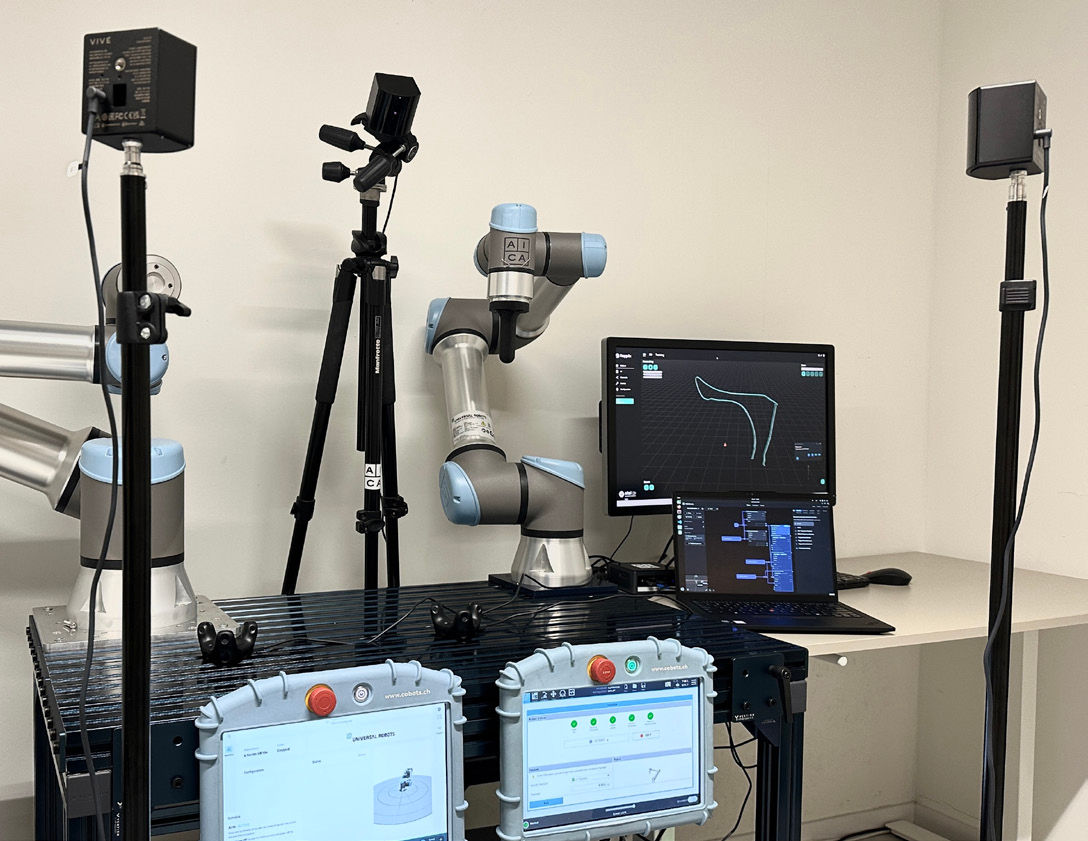
At Automate 2026, the Universal Robots (Teradyne Robotics) booth featured a UR7e robot executing learned trajectories from human demonstrations that are both adaptive and force-sensing. The robot picked up a metal part and buffed it against a polishing wheel.

Christopher Savoia, global head of UR+ Ecosystem, took me on a tour of the booth to explore the evolution of Physical AI across several robotic applications.

Both the e-Series and UR series robots, for example, have a built-in end of arm force torque sensor that can be leveraged for force sensitive control. In UR terminology, this feature is called force mode and can be used to perform motions along a desired direction or path while being force compliant in certain axes or directions.

According to Enrico Eberhard, CTO and co-founder of AICA, the hardware provided by AICA provides special tools and functionalities unique to UR robots including advancements to force sensing technology. The true power of this advancing technology comes from the versatility it offers to manufacturers. AICA has provided additional case studies in areas like screwdriving, polishing and assembling from prototyping to production across several industries.

AICA’s Smart Assembly software reduced the required time to parameterize a new batch from days to just one hour.

Reinforcement Learning

[advertisement]

On the industrial side, reinforcement learning has shown its strength in complex, high-precision tasks like this gearbox assembly example. AICA took a deeper look at these technologies in a blog posted earlier this year called “Deep Reinforcement Learning: A New Frontier for Robotic Arms,” where they hinted at the shift taking place when robots are allowed to learn from experience and can discover solutions that human engineers might not think to program at all.

“Deep reinforcement learning is famously data-hungry, often requiring millions of trial-and-error interactions to learn a task. Running that many trials on a physical robot isn’t practical, it would take weeks, wear down hardware, and burn through resources. That’s why most training happens in simulation, where data is cheap, fast, and safe to collect.

Of course, simulations are never perfect. Even small mismatches between simulated and real-world physics, like slight changes in friction or lighting, can cause learned behaviors to fail once deployed. This sim-to-real gap remains a major hurdle in robotics. To close it, engineers enhance simulator realism by tuning physics parameters and use techniques like domain randomization and actuator dynamics modelling to train policies that can handle real-world unpredictability. Even when a policy works, understanding how it works can be tricky.”

The blog went on to examine how neural network controllers may be effective, but they often lack transparency.

“It’s difficult to know why a robot made a particular decision or how to adjust its behavior. As a result, many companies take a conservative approach: once a deep reinforcement learning policy is trained, they ‘lock it down’ and ship it as a fixed black box. It works, but you can’t inspect or modify it, much like proprietary software. This limits flexibility. Developers can’t easily adapt or build on top of it, and making small changes can require retraining from scratch. Yet this is a smaller issue when working with compact, well-trained policies designed for highly specific tasks, where the model’s scope is narrow and its behavior easier to characterize.”

Deep reinforcement learning isn’t a silver bullet, according to the AICA blog, but with the right tools and approach, it’s transforming robotics. Tasks that once seemed impossible to automate are now within reach.

AICA and Replixx (a hosting replication software) create AI content tools to automate manufacturing workflows and provide technical support.

Industrialization & Series Production

The Schaeffler gearbox assembly project is one example. After a successful proof of concept and multi-month endurance testing, the gearbox assembly solution was officially deployed in Schaeffler’s Greater China production facilities. This included the development and adaptation of the AI-driven Smart Assembly software directly into Schaeffler’s processes. It also included a cross-regional technology rollout and validation and long-term monitoring to track system performance.

By the numbers, Schaeffler achieved a 98 percent success rate with 75 percent less downtime and a 40 percent markdown on expenses. This combination of adaptive learning, real-time control and modular software increased efficiency while reducing cost, complexity and risk.

In the past, a robot could only handle tasks that engineers anticipated ahead of time. Today, complex and unstructured tasks cannot be captured through instruction or prevention, it’s now the job of robots—supported by advanced software architecture—to figure out production steps in real-time. Physical AI is allowing robots, drones and autonomous vehicles to look at complex challenges and figure out solutions without assistance from their human counterparts. We’re entering a whole new level of autonomy with success stories like this.

aica.tech

universal-robots.com

schaeffler.com

[advertisement]