


[advertisement]
Feature Articles

October 14, 2025


Aaron Fagan


Features

Precision Under Pressure

Meeting the demands of modern gear grinding

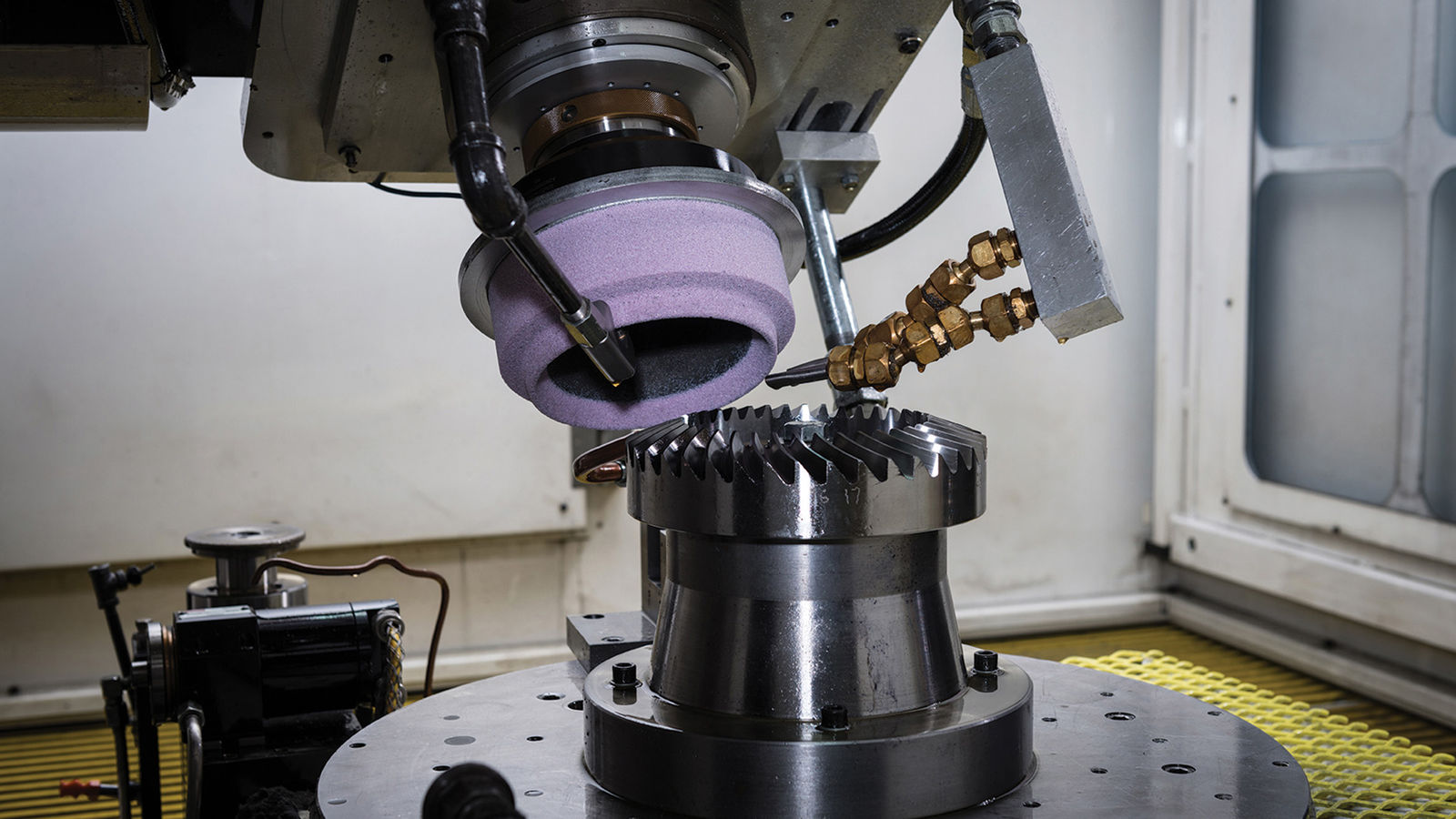
As gear manufacturers face increasing pressure to meet tighter tolerances, achieve higher profile accuracy, and deliver superior surface finishes, grinding technology is playing a more central role than ever in precision transmission manufacturing. Norton Saint-Gobain Abrasives is addressing these challenges head-on with the rollout of its next-generation grinding solutions—most notably, a new bond system known as VS3PN.

A Bond That Does More Than Hold

According to Spencer Artz, senior application engineer at Norton|Saint-Gobain, the VS3PN bond represents a significant departure from traditional wheel design. “An ideal bond in any grinding wheel will effectively retain the sharp abrasive, have enough porosity for coolant and grinding chips, and release any worn abrasives when they are no longer efficient,” Artz said. “Additionally, a high-quality bond will reduce interaction between the bond and the workpiece to avoid heat generation.”

The VS3PN bond goes a step further. “The bond incorporates a novel technology in which friction between the bond and workpiece is significantly reduced,” he explained. This lowers grinding temperatures and forces while improving grinding wheel performance and workpiece surface integrity, particularly important for heat-sensitive components and high-accuracy gear forms.

Cost Savings Through Longevity and Support

Artz emphasized the business case as well as the technical gains: “Early adopters of the technology have experienced significant cost savings through increased parts per dress and reduced dressing passes.” He also noted that Norton’s process support plays a crucial role in successful implementation. “While the abrasive technology is top tier, the application support we provide to optimize the wheel and process cannot be understated. Customers will have peace of mind that their new process will be optimized, stable, and burn-free.”

Superabrasives: Where They Fit

While conventional bonded abrasives remain dominant in many gear grinding operations, Norton is also pushing the performance envelope with superabrasives, particularly vitrified cBN.

“There’s no single rule for when to switch,” Artz explained. “A typical example is when the customer has a very difficult-to-grind material and the cost per unit with conventional abrasives would be higher than a superabrasive grinding wheel. Another example involves the volume of material removal—if a lot of volume is involved and material removal rates are high, that helps justify the switch.”

Share and save:


This article appeared in the September/October 2025 issue.


Read PDF

[advertisement]

High production volume applications requiring tight tolerances, short cycle times, and low grinding temperatures are particularly well-suited to vitrified cBN.

Grain & Bond Selection Guide for Gear Grinding*

Application PriorityRecommended Grain TypeBond SystemNotes
High stock removalTQ / TQX shaped grainsVortex 2 or VS3PNStrong cutting action with good chip clearance
Tight tolerancesQuantum Prime (NQN)VS3PNBest for form holding and cool grinding
Difficult to grind materialscBNVitron 7Ideal for superalloys or high volume production
High wheel speedsQuantum PrimeVS3PN (qualified for 100 m/s)Balance of strength and cool cutting
Cost-per-part focusAluminum oxide blendsVS3, VTX2Suitable for mid-performance applications

*Consult application engineers to determine machine compatibility, dressing system limitations, and cooling requirements.

Targeting Performance Improvements

“When it comes to superabrasives, we strive to achieve at least 20 to 30 percent more performance with each new generation,” Artz said. That includes better form-holding, longer wheel life, and reduced risk of burn—all critical when working with hardened steels, carburized surfaces, or aerospace-grade components.

The Right Grain for the Job

Grain selection is increasingly application specific. Norton offers a growing lineup of abrasive grain types—including Quantum Prime (NQN), shaped grains like TQ and TQX, and various agglomerates of aluminum oxide with Vortex Generation 2 and 3. These grain types are paired with optimized bonds, including the latest VS3PN system. “Depending on market and customer requirements—whether cost, quality, or productivity—we tailor grain and bond combinations accordingly,” said Artz.

He also noted that the debate between bonded and superabrasive solutions often comes down to how performance is measured. “Cycle time could be measured by wheel life—in which case superabrasives have an advantage—but if you go by cost per part, then bonded abrasives with elongated grains and the new ceramic grains may be more economical.”

Standard bond (left) vs. Next Generation VS3PN Norton Bond (right).

Technical Variables and Gear Grinding Strategy

Artz outlined a set of key factors manufacturers should consider when selecting a grinding wheel:

  • Machine capability
  • Workpiece material
  • Grinding stock allowance
  • Part sensitivity to heat or burn
  • Cycle time
  • Process stability

These variables combine to dictate not only the tool choice but the stability and repeatability of the entire grinding process.

High-Speed Trends and the 100 m/s Frontier

Worm gear grinding speeds are increasing. “Most, if not all, OEMs now offer 100 m/s wheel speeds for worm gear grinding to further reduce cycle times,” Artz said. While 80 m/s is still standard, Norton has already qualified wheel specifications for the next threshold.

Higher wheel speeds reduce machining time but place greater structural and thermal demands on grinding wheels. “Gear precision is constantly evolving to address transmission life, fuel efficiency, and noise,” Artz said. “Form holding can simply be improved by increasing the amount of bond in the wheel, but that increases the risk of burn—which is a nonstarter.”

With the VS3PN bond, Norton aims to thread that needle. “VS3PN, paired with premium grain technologies like Quantum Prime, allows us to provide the longest-lasting, coolest-cutting worm gear grinding wheel in the industry.”

Conclusion: From Process Step to Strategic Tool

[advertisement]

Gear grinding is no longer just a finishing step—it’s a critical part of modern precision manufacturing. With new bond systems like VS3PN, superabrasive vitrified cBN offerings, and a portfolio of premium grains, Norton Saint-Gobain is giving gear manufacturers the tools they need to achieve accuracy, speed, and repeatability in one package.

As gear design, material science, and process automation evolve, abrasive technology must evolve with them. With performance-focused innovation and a commitment to application support, Norton is helping transform gear grinding from a constraint into a competitive advantage.

nortonabrasives.com