




Self-Consuming Artifacts
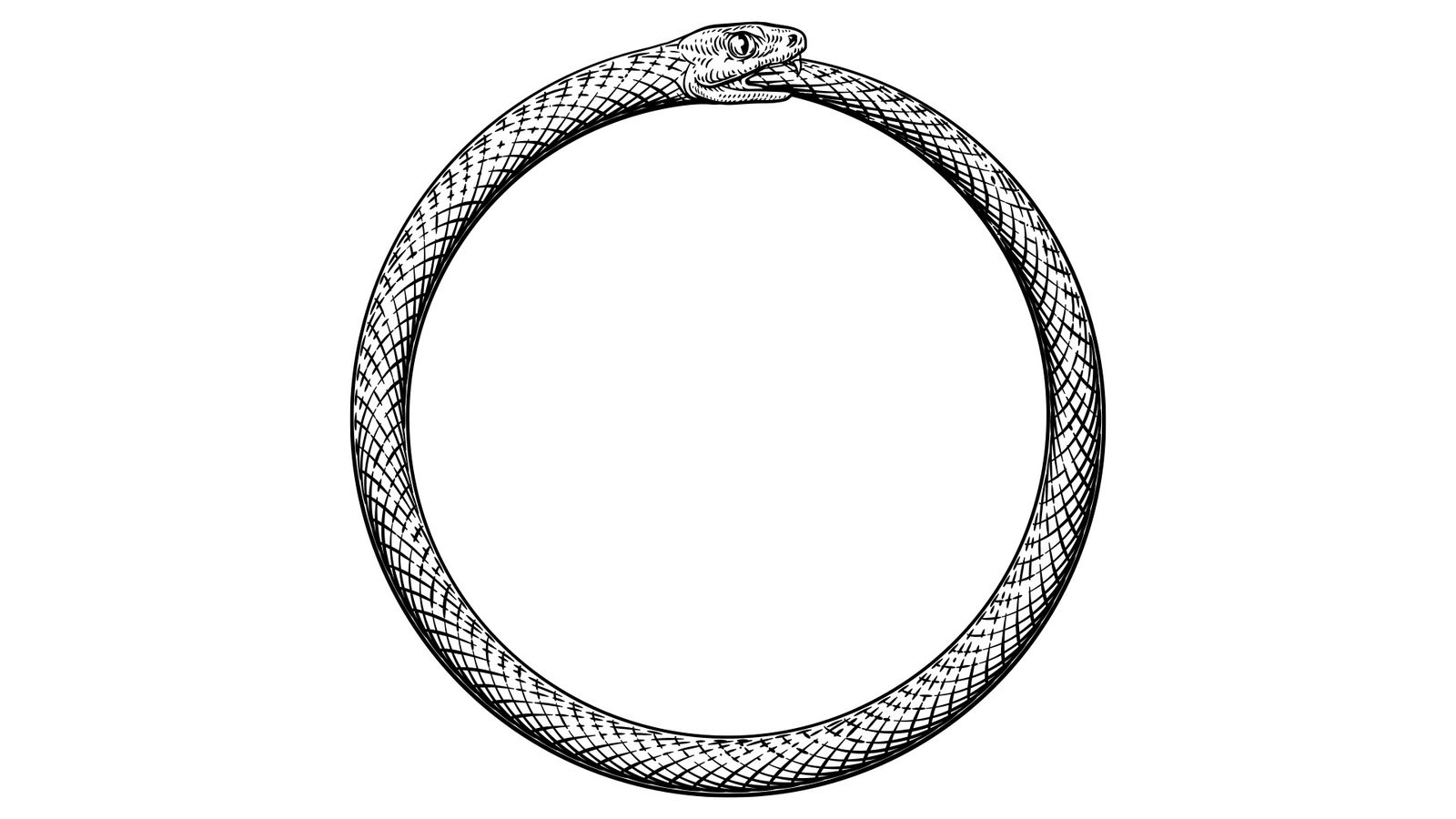
The ouroboros, an ancient symbol of cyclical self-consumption. The serpent must pass through its own undoing to continue, not unlike an engineering ideal that has to break down under real-world conditions before it can be rebuilt into something that works.
I’ve been rereading Self-Consuming Artifacts by Stanley Fish, published in 1972, a classic of literary criticism on the experience of reading, and now I see its central thesis everywhere. Fish argues that certain texts don’t deliver a meaning so much as put you through something. They build a framework, make you invest in it, and then show you its limits. The text, as he puts it, consumes itself: “it is self-sharpening and what it sharpens is you.” I realize this sounds like an odd thing to bring up in Gear Technology, but one hopes every issue of the magazine is in some way an active experience that requires the reader to work, question their own assumptions, and possibly change their perspective.
As I was editing Dr. Stadtfeld’s conjugate bevel and hypoid gear piece (p. 40), Fish’s argument kept rattling around in my head. Dr. Stadtfeld thoroughly builds conjugacy up for pages: the fundamental laws of gearing, involute development, the generating gear principle, straight bevel geometry, and hypoid pitch surfaces. The tooth contact analysis results are unreal: zero motion error, perfect line contact, Ease-Off graphics you could set a drink on, and by Figure 11, you’re a true believer. However, this is only the mathematically exact answer to the problem of two gears meshing; he then introduces fifty microns of offset error, fifty microns of pinion cone displacement, thirty arc-minutes of shaft angle change (numbers that would be unremarkable in any production gearbox), and the whole thing comes apart—contact migrates to the tooth edges, load concentrations spike, and what follows is noise, pitting, and tooth fracture. He calls conjugacy “a false objective,” which is a stunning conceit to deploy after pages of proving it works. But that’s exactly Fish’s move, and Dr. Stadtfeld leads us through the construction, so the departure is meaningful.
Once I had that lens on, the rest of the issue started falling into place. Dr. Zarębski’s piece (p. 37) on bevel gear profile shifts is a subtler example: the elaborate formulation with independent coefficients produces geometry identical to the standard zero-sum approach with a modified pressure angle, but you have to go through the elaborate version to see that. In an interview (p. 18) with Lance Brown, MPMA senior technical instructor, he shares that a client once asked him to skip the involutometry and get straight to why their gears were breaking. He obliged—he’s a good teacher—but you can hear in the interview that they would get theory whether they knew it or not. Without it, failure analysis is just pointing at damage.
The Productive Robotics story (p. 22) is four years of a concept consuming itself into a process. Not just self-consuming but recursive, a cobot manufacturer uses its cobots to deburr the gears its cobots contain. I won’t belabor the whole issue into the same frame, though much of it fits. Fish thought the most honest texts were the ones that made you earn the disillusionment. That the getting-there mattered more than the conclusion. I think he was talking about reading, but he could have been talking about engineering. As it happens, I wrote this issue’s Addendum “Constructive Failure” at the back of the book months before any of these pieces crossed my desk.