



[advertisement]
Feature Articles

December 15, 2025


Aaron Fagan


Manufacturing Grinding Hobbing Inspection Education & Training Workforce Features Gears Bevel Gears Helical Gears

Walk with Purpose

How Jared Lyford of Forest City Gears walks the walk and talks the talk when it comes to workforce development

When you talk with Jared Lyford, director of operations at Forest City Gear and the newly appointed president of the Rock River Valley Tooling & Machining Association (RRVTMA), it becomes clear very quickly: workforce development isn’t a program for him. It’s a calling—and one shaped by lived experience.

The phrase that encapsulates his philosophy is one he heard as a teenager in an apprenticeship program at Forest City Gear himself: Walk with purpose. It was not a slogan; it was an ethos—instilled by a mentor who believed that the way you move through a building says something about the way you move through life. As the saying goes: How you do anything is how you do everything.

Lyford recalls, “He said, it doesn't matter if you’re going from point A to point B, or you’re going from your workstation to lunch, or you’re leaving at the end of the day—always walk with purpose. Have your head up, walk forward, act like you have intention. If you act like you have intention, you’re going to feel like you have intention and you’re going to be recognized like you have intention.”

More than 25 years later, that mindset still guides him—from the shop floor to the boardroom.

From Apprentice to President 

Lyford’s recent appointment to RRVTMA board president represents a full-circle moment in his career. The RRVTMA is a local chapter of the National Tooling & Machining Association (NTMA), serving area manufacturers through networking, training resources, and apprenticeship pathways.

“The purpose of the chapter is to organize local manufacturers to get the membership perks of the NTMA and more… one of the main things we provide is training and apprenticeship tracks for people within manufacturing.”

Share and save:


[advertisement]

The association offers a four-year precision machining apprenticeship with 8,000 hours of on-the-job training for gear manufacturing or a 10,000-hour tool and die track, and includes 160 hours of coursework through a partnership with Rock Valley College. Successful apprentices earn not only state credentials but federal recognition: RRVTMA apprenticeships are accredited by the Department of Labor, meaning graduates are officially indentured journeymen in the trade. 

Lyford now leads the organization he once went through himself. “My initial ideas are to continue the work the board has started and provide ongoing strategic direction to improve member value—as well as the quality of output for the apprentices—to maintain or provide more offerings.”

At Forest City Gear—A Workforce Strategy 

At Forest City Gear, Lyford occupies a role with reach: coordinating manufacturing operations, facilities, and capital expenditures for a company that supplies gearing for aerospace, defense, and space applications.

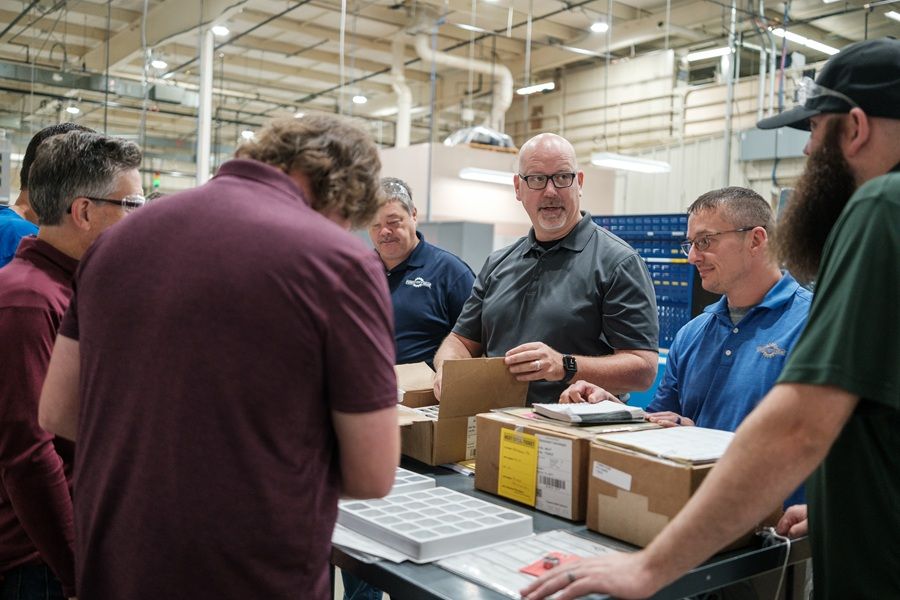
Jared Lyford, director of operations, Forest City Gear.

“We are a contract manufacturer for loose gearing… We build completely to the customer's design.”

But gearing alone isn’t the biggest challenge—staffing is.

“There’s a skills gap—and in order to find turnkey talent to satisfy immediate capacity needs is challenging.”

Forest City Gear meets that challenge through extensive training, using both internal resources and outside expertise. “We utilize Helios, Gleason, Kapp, and all of their resources—and we’re very active with the AGMA and AGMA’s training—to help technicians get a more in-depth understanding of what they’re doing.”

The need is urgent. “We’ve just gone through a transitional time where the boomers are leaving the workforce and Gen X is aging… it becomes critical to build that pipeline.”

The Long Path to Clear Direction 

[advertisement]

Lyford didn’t arrive at this philosophy from a textbook. It was earned through trial, transition, and recalibration.

As a high school student, he entered a competitive vocational program supported by 21 local companies, including Forest City Gear. He was the highest-scoring aptitude test candidate from his school, and by the time he graduated, he was already setting up gear inspection equipment—getting hands-on experience that few students ever receive before entering the workforce.

He started full-time at Forest City Gear, but another principle stayed with him—this time from a tool and die maker who asked what he planned to do with his future. When Lyford admitted he wasn’t sure, the man replied: “If you don’t get a degree, get a trade.”

He never forgot that. When someone else later suggested he would make a good tool and die maker, he followed the advice—left Forest City Gear—and eventually earned his journeyman’s credential through the same RRVTMA program he now leads.

Then 9/11 hit. The company he worked for contracted. Lyford suddenly found himself overqualified for many positions and underutilized in others. He spent time working in automation and assembly, gaining new skills but questioning his trajectory.

One day in the tool room, everything changed again. Someone waved a newspaper in his direction. On the front page was Fred Young of Forest City Gear, standing beside a headline that read “In High Gear.” Lyford called that night. Forest City Gear remembered him. A door reopened. A framed copy of that article is displayed above his desk.

Full Circle but Gear Shaped 

In 2009, another challenge—and opportunity—arrived. Wendy Young approached him with a question: would he consider going back to school for a business degree? He said yes immediately.

“I went to Rockford University in their bachelor’s program for business management… I graduated in 2013, and when I graduated, I really full-circled that and said, the thing was, if you’re not going to get a degree, get a trade. I had gotten a trade… and then I had the opportunity to pursue the degree.”

But he’s quick to point out something crucial: for many people, the trade-first, degree-second path is not only viable—it may be more effective.

“If I had gone straight to college from high school, I wouldn’t have had direction… I think a lot of people have to be able to walk with purpose—to show intent—and carve out a space for themselves.”

That belief now shapes his approach to workforce development. Young people don’t necessarily need immediate clarity—but they do need exposure. They need mentors. They need opportunity. Most of all, they need intention.

Walking Forward 

Today, whether at Forest City Gear or RRVTMA, Lyford speaks about workforce development with clarity—not as a slogan, but as a commitment. Manufacturing relies on systems, but systems only work if people do.

When asked to summarize Forest City Gear’s philosophy in a single sentence, he didn’t hesitate:

“Training and workforce development is non-negotiable—that’s something you have to do without consideration to risk or cost,” Lyford said. “Yes, someone may leave after you’ve invested in them. But if you take a holistic view, that investment still develops the capability of our industry as a whole. You’re building the future—whether they stay or not.”

Looking back, the common thread is clear—and it brings him to the phrase he first heard in a vocational classroom: Walk with purpose.

In an industry searching for talent, clarity, and direction, those three words may be more than personal wisdom. They may be the blueprint—for companies, careers, and the future of American manufacturing.

forestcitygear.com

rrvtma.com

ntma.org


[advertisement]