


Additive Manufacturing at Scale
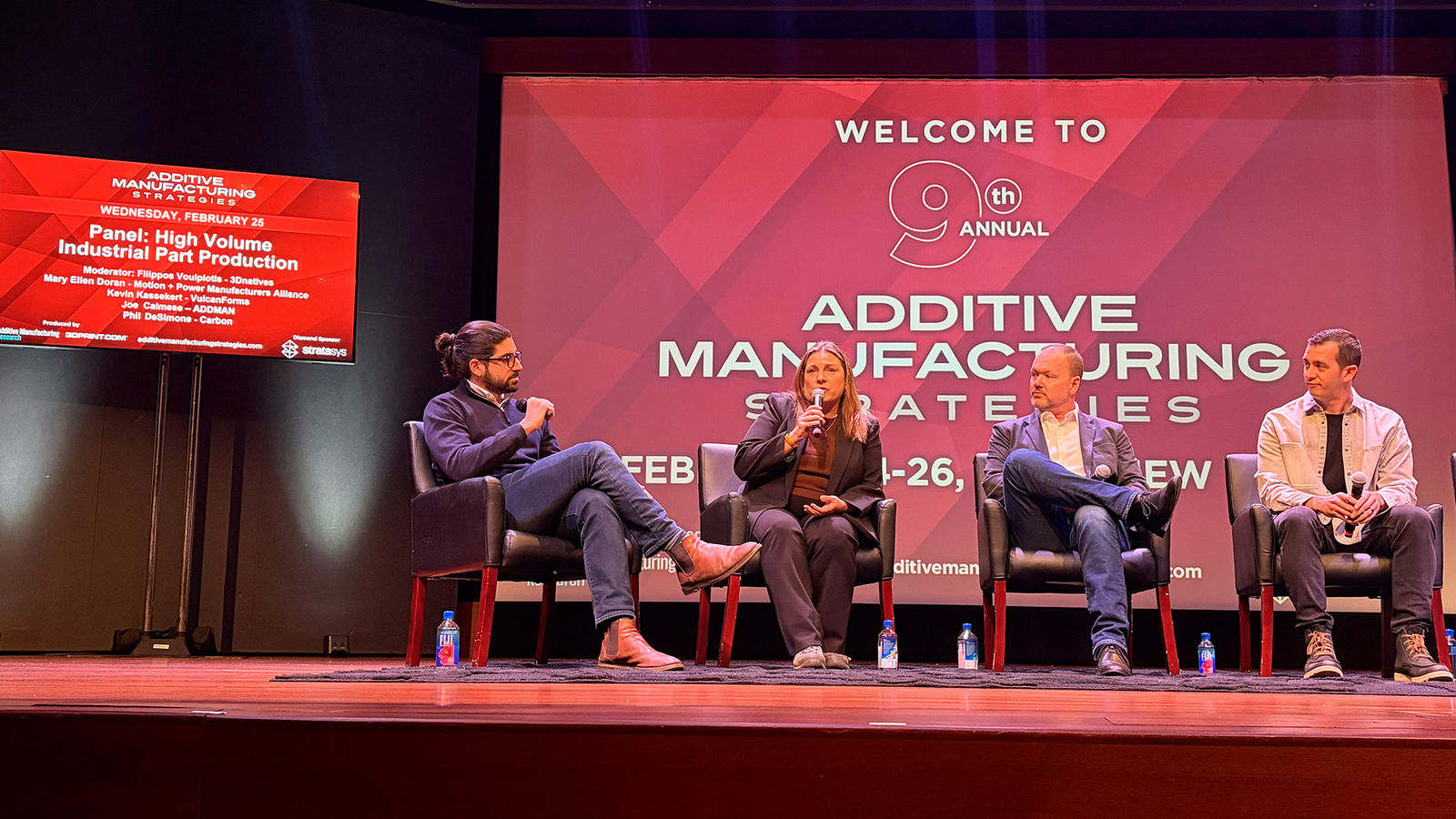
From left, Filippos Voulpiotis, managing director of 3Dnatives, moderates panelists Mary Ellen Doran, vice president, MPMA Emerging Technology; Kevin Kassekert, CEO of VulcanForms; and Phil DeSimone, CEO of Carbon. (Image: Additive Manufacturing Research)
In February, I had the privilege of being invited to speak on a panel at the Additive Manufacturing Strategies (AMS) conference in New York City. AMS is a three-day, in-person event that brings together leaders from across the additive manufacturing space, including investors, OEMs, researchers, and end-users. I was honored to represent MPMA and the motion and power transmission community in a room full of people who live and breathe this technology every day.
My panel, “High Volume Industrial Part Production,” was moderated by Filippos Voulpiotis, Managing Director of 3Dnatives. Joining me were Kevin Kassekert, CEO of VulcanForms, and Phil DeSimone, CEO of Carbon. One representative from metal and one from polymer additive manufacturing. These are not small names. VulcanForms, based in Massachusetts, operates purpose-built digital factories that combine laser powder bed fusion, precision machining, and AI-driven software into a single end-to-end production platform, serving aerospace, defense, medical, and transportation sectors. Caron’s subscription-based platform is built around their proprietary Digital Light Synthesis process, paired with advanced photopolymer resins and software that allows brands to design, develop, and manufacture high-performance parts at scale—from NFL helmet liners to dental devices to industrial components.
The central question driving our discussion was deceptively simple: What does it take to produce industrial parts at high volume using additive manufacturing? The honest answer is that we are still working it out and that tension between the promise of AM and the realities of scaling it was a thread woven through the entire conference.
From my vantage point, the most valuable part of being in that room was the intelligence I could bring back to MPMA’s 3D Printing Committee as we continue to educate the gear and bearing industry on additive manufacturing. Our members need to understand where the industry stands today. They don’t need the headlines but the ground-level reality of what is production-ready, what is still maturing, and where the honest barriers remain.
The components our members make—precision gears, actuators, and drive systems—are exactly the kinds of parts where additive manufacturing either opens new doors or hits a wall. Tolerances matter. Material properties matter. Cost per part at scale matters enormously. But most importantly, engineers need to think about all the tools available to solve problems.