




Firetruck
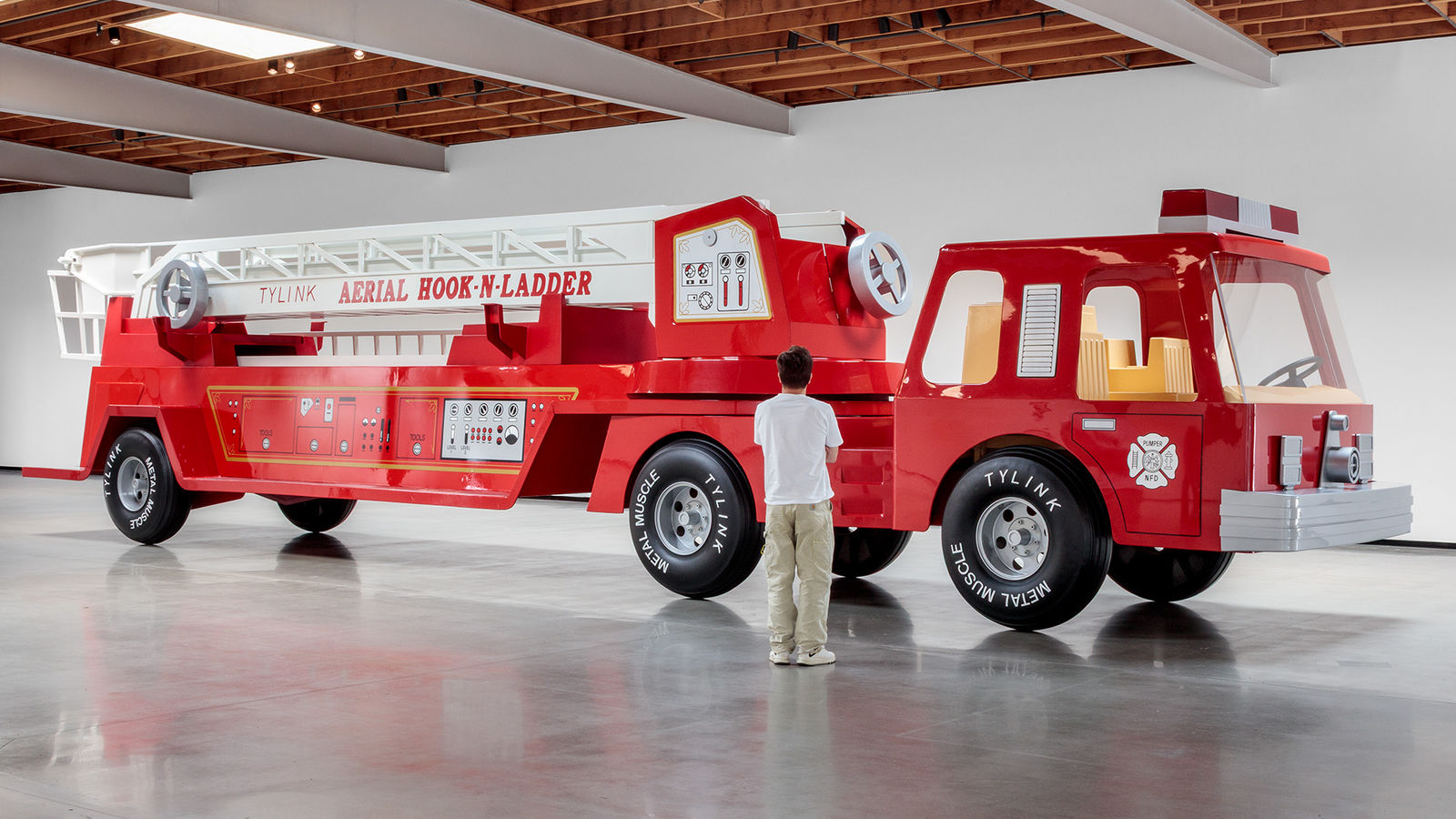
Charles Ray, Firetruck, 1993; painted aluminum, fiberglass, and Plexiglas; 144 × 96 × 558 in. Photo by Joshua White / JW Pictures. Courtesy of the artist, Matthew Marks (New York and Los Angeles), and Jeffrey Deitch (New York and Los Angeles). Collection of The Broad Art Foundation. © Charles Ray
In light of the United States’ semiquincentennial, few images are more quintessentially American than a Fourth of July parade with bright red fire engines. There’s a Charles Ray sculpture that caught my attention—owned by The Broad and rarely on view, but recently shown indoors, of all things, at Jeffrey Deitch Gallery in Los Angeles—titled Firetruck (1993). It’s a child’s toy fire engine built at the scale of a real one. Is this a real fire engine that has become a toy, or is it the other way around?
Ray reads a cultural object down to its engineering and then sets it just slightly wrong against the world, so that one might notice the world more and the object less. We have all noticed things that somehow feel a bit off in a way we can’t quite explain. These moments rouse our attention from its automatism, curing us of a numbness to our surroundings, however briefly, allowing us to see what we had stopped seeing. The term for this technique is ostranenie, meaning defamiliarization or, more specifically, making what is familiar strange and what’s strange familiar.
Part of how Firetruck sits wrong is that it is gloriously hollow. The materials list is modest: painted aluminum, fiberglass, and Plexiglas. A form that promises an entire machinery of function and then doesn’t contain any of it. A fire engine with no engine. Imagination fills in the blanks because some part of us knows what a fire engine is supposed to be.
Suppose Ray had built the engine. Suppose the gears were in there, cut and meshed and correct, turning nothing. Real gears but toy gears. The meaning of a gear is contingent on its function within a whole; alone, it is a beautiful, useless artifact. So while the gear is a part without a whole, Firetruck makes me see the other side; it is all whole and no parts.
Ray has been resistant to showing Firetruck indoors up to now, suggesting it was meant to live outdoors and weather “like a toy abandoned in a sandbox,” as Deitch Gallery put it. A toy left out long enough stops being a toy at all. And so it is with our country, old at being young and new at being old.
Two hundred and fifty years on, the United States has weathered into something true. We are old enough now to know there is something hollow at the heart of the American Dream and to love it anyway, because we know exactly what we pour into it. Not a plaything outgrown, but a thing made real by being left out long enough to take the weather.