


HWR Workholding Demonstrating New Solutions at IMTS 2026
HWR Workholding USA has announced that IMTS 2026 will feature the North American debut of two new products within its INOFlex family of flexible, high-performance 4-jaw chucks. The company will also be showcasing a comprehensive sampling of its full range of workholding solutions for turning and milling applications. Additionally, attendees who visit the company’s Booth #431579 in the West Building will receive a commemorative German-style beer boot pint glass.
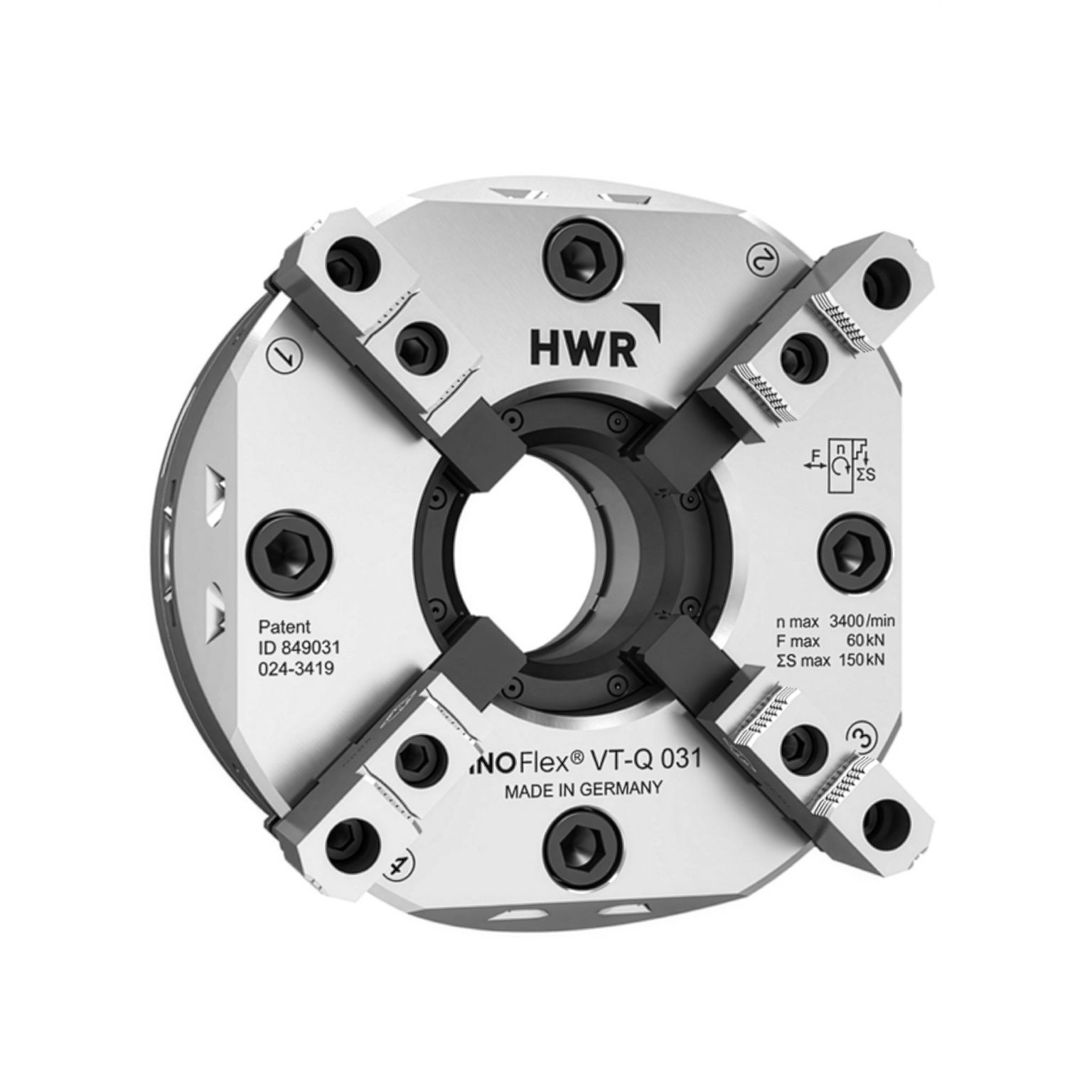
All INOFlex chucks incorporate a centric compensating clamping system that allows each pair of jaws to move independently of the other. This design automatically centers and securely holds workpieces, regardless of if they feature a round, rectangular, or asymmetric geometry. The resulting level of flexibility allows users to efficiently process a wide range of parts.
Developed specifically for the optimization of automation on milling machines, INOFlex VF-A chucks use hydraulic actuation for fast, precise workpiece transfer. The VF-A is available in chuck sizes from 220 mm (8.7") to 700 mm (27.6").
A power chuck featuring a quick-change jaw system for fast changeovers, the INOFlex VT-Q includes a through-hole for open-center or partial open-center clamping. The VT-Q is available in chuck sizes from 220 mm (8.7") to 400 mm (15.7").
HWR will also be showcasing INOFlex VL chucks featuring a unique weight-reduced design that makes them ideal for integration within 5-axis milling machines. Visitors to HWR’s booth will see the VL100, which accommodates parts to a maximum diameter of 2,000 mm (40.0"). INOFlex VL is available in chuck sizes ranging from 325mm (12.8") to 2000mm (78.7")
Manufacturers working with delicate or thin-walled parts will have the chance to see two complementary solutions for these challenging applications. INOZet pendulum bridges allow manufacturers to quickly and easily double the number of jaws on nearly any existing chuck that is 200mm or larger. This more effectively distributes clamping forces and reduces the risk of part distortion.