

[advertisement]
Technical Articles

March 4, 2026


Dr. Hermann J. Stadtfeld


Technical

Interchangeability of Gears

The following chapter is from Gear Technology Solutions (The Gleason Works, 2025) by Dr. Hermann Stadtfeld. This is the first of four excerpts that have been provided to Gear Technology readers to offer a preview of the book’s insights into bevel gear theory, design, and manufacturing.

Exchange of One Member During Gearbox Service

Certain industries that apply large gears in earthmoving and mining equipment request the possibility to exchange a broken, damaged, or excessively worn gear member without replacing its mating member. At first, this appears to be contrary to good mechanical practices. However, these gears in question might have diameters of 500 mm to 2,000 mm and weigh, in some cases, several tons.

The weight and the waste of expensive material, including the value added on the way from a soft steel blank to the finished gear, are compelling arguments not to replace a perfectly good gear. Also, the additional repair hours and the required equipment can be very costly. If the mating member of the damaged gear shows no damage, such as cracks or excessive wear, then the exchange of a single member should be considered.

For Which Kind of Gears Can One Member Be Exchanged?

Couplings and clutches will allow a single member exchange if the mating member does not show any fretting or cracks.

Straight bevel gears can also be exchanged if they are, for example, standard Coniflex gears where the lead function is a straight line and the tooth contact is established by the pressure angle and a standard length and profile crowning.

Spiral bevel gears are more delicate to replace. Here, the cutter diameter, the spiral angle, and the manufacturing method have to match the original components. Face hobbing and face milling are not interchangeable with each other. Generated gears cannot be replaced with nongenerated (Formate) gears. In the case of face hobbing, next to the cutter radius, the number of cutter starts is identical to the original manufacturing method. In critical cases, the damaged gear must be measured with a coordinate measurement machine. The surface measurement results can be used to reconstruct the correct surface form by applying a reverse engineering approach. If the damaged member is too degraded to perform a good measurement, then the mating member must be disassembled and undergo an inspection measurement. Also, in this case, it is possible to create the damaged member with sophisticated computer software. However, in most cases, the latter is unrealistic.

Share and save:


This article appeared in the January/February 2026 issue.


Read PDF

[advertisement]

Hypoid gears are, in general, not used for these large applications. It would be considerably more difficult to create a replacement pinion or gear for a hypoid design.

In face gear sets, it is easy to replace the cylindrical pinion. However, if the basic parameters of the cylindrical pinion are known, it is also possible to design and machine a replacement face gear.

The Procedure of Correct Replacement Gear Assembly

The wear of the pinion and gear will increase the backlash in a used unit. If the backlash in the new set is an amount of X, then before replacing a worn or damaged member, the backlash of the gearset should be measured on the outside of the ring gear as shown in Figure 1 (Ref. 1). If it is not possible to measure backlash due to the damage, then the backlash after replacing the damaged member should be adjusted to the maximum of the defined backlash range.

Figure 1—Measuring the backlash of a bevel gearset.

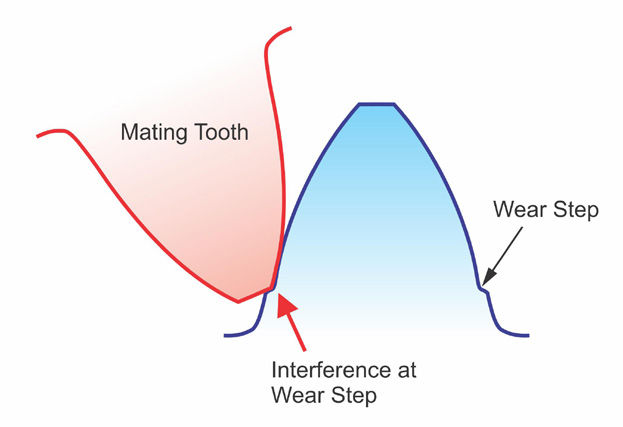
Adjusting the backlash at the time of replacing one member reduces the risk of root interference due to the wear step (see Figure 2) and small flank form changes on the member that is not replaced.

If there is a severe wear step between flanks and root fillet transitions on the member, which is not replaced, then the likelihood of an interference problem still exists. A severe wear step, as shown in Figure 2, can be detected visually or with a drawing pin.

Figure 2—Wear step in the root of a used gear member.

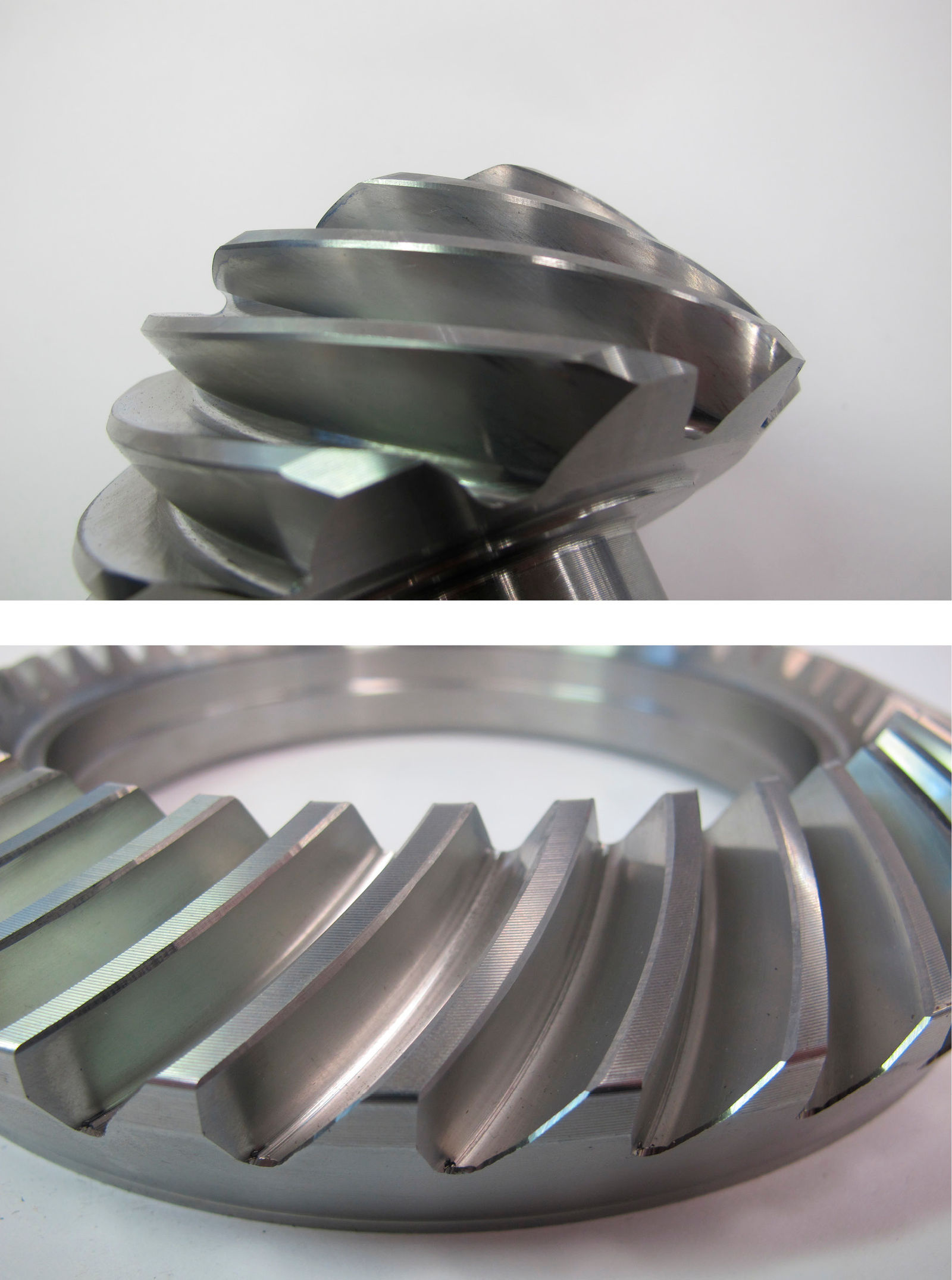
To account for a severe wear step in the root of the undamaged member, the replacement gear must be topland chamfered to prevent interference between the topland corner of the replacement part and the wear step between the flank and root on the teeth of the new member. Topland chamfering is not a widely used standard practice for the case of single-member replacements. The consequence of not applying the service backlash and the topland chamfering is, in many cases, a repeated failure of the unit in question and a costly repeated repair. Topland chamfers, as shown on a pinion (top) and a gear (bottom) in Figure 3, should only have a width of 10 percent of the whole depth of the teeth and an angle that is about 30 degrees to the flank profile at the tip of the teeth. Curved tip roundings are even better than straight chamfers and are recommended if the provision of machining these is available. Rounded top-land corners have advantages over straight chamfers in the case of replacing damaged and worn gears.

Figure 3—Topland chamfer on a pinion (top), and on a gear (bottom).

Mixing Straight Bevel Gears Made with Two-Tool Generators and Coniflex Gears Made with Circular Cutters

The question if older straight bevel gears, manufactured with a two-tool generator, can be replaced by Coniflex parts, cut with a circular cutter, is “yes”. The flanks are the same, and the differences are only at the root. If the correct build procedure (for new and old single-member replacements) is followed, then the flanks and the tooth tips never get to see the clearance area below the flank root transition of their mating member. The tooth tips only roll down to the wear step. Any complications due to wear-step interference are resolved by the application of topland chamfering.

Strength of Coniflex Parts Made with Circular Cutters

Most applications where single gear members are replaced apply to straight bevel gears. For this reason, this section about strength comparison was added to this chapter. The question was raised whether the strength of a Coniflex pinion or gear may be lower than the strength of a gearset that was originally manufactured with a two-tool generator.

Regarding the comparison of Coniflex straight bevel gears, which have a curved root line with straight bevel gears with a straight root line, the following facts can be presented:

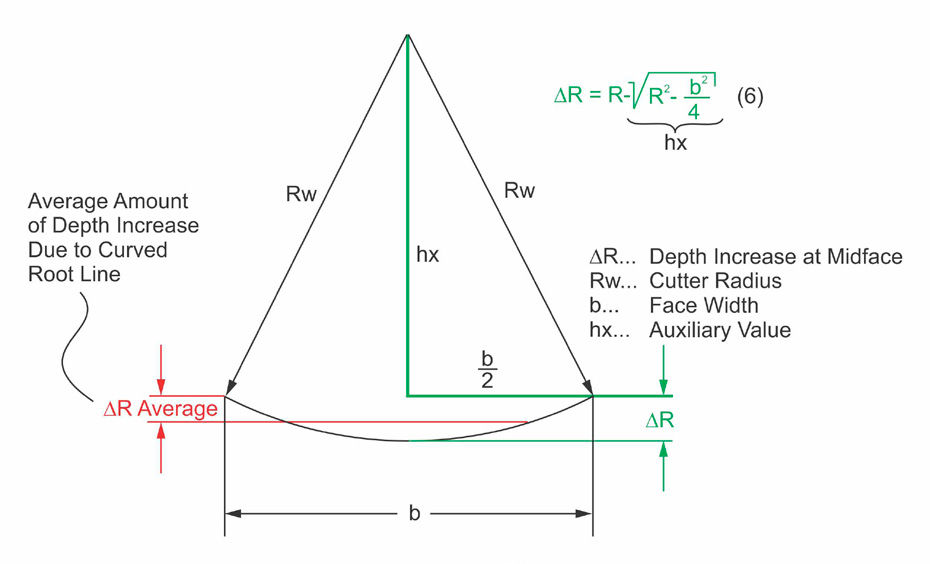
The curvature of the root line depends on the cutter radius, which results in a deeper tooth at the center of the face width. The calculation of the additional amount of root depth ΔR is explained in Figure 4.

Figure 4—Relationship between cutter radius, face width, and ΔR.
[advertisement]

Several industrial users of Coniflex straight bevel gears claim that they experienced a dam effect, which increases the moment of inertia in the tooth bending direction compared to a noncurved root line.

A second positive effect is caused by the hourglass shape of the root slot width. Not only is the tooth depth larger at midface, but also the tooth thickness below the flank working area increases by:

(1)

In the root bending stress calculation, the increase of root tooth thickness reduces the bending stress quadratic while the moment arm from the force application point to the root (due to the depth increase) only increases linearly. This shows in the root bending stress calculation (e.g., in a deflection beam calculation) as follows:

(2)

(3)

(4)

(5)

Whereas:

a… Pressure Angle at Flank-Root Transition

M… Bending Moment

W… Section Modulus

b… Face Width

h… Tooth Root Thickness

l… Force Application arm = Module

F… Force

σ… Root Bending Stress Calculated as Cantilever Deflection Beam

For example, the formal relationship in equations 1 through 8 applied to a straight bevel gear with a straight root, which has a module of 5 mm, a face width of 30 mm, and a root tooth thickness at the center of 7.5 mm, shows that for a force of 12,500 N, the root bending stress is equal:

(6)

For a comparable Coniflex bevel gear with a root which is DR = 1 mm deeper at the center and 0 mm deeper at the ends, the following assumptions can be made:

Average value of deeper root over entire face = 60 percent of value at center (1 mm• 0.6=0.6 mm). Pressure angle at the stress critical 30-degree tangent is 30 degrees. The resulting root bending stress is equal:

(7)

The comparison example in Equations 6 and 7 shows that the effect of taller tooth at midface and larger root tooth thickness at midface cancel each other out, such that the Coniflex straight bevel gear shows even some reduction of calculated root stress compared to the straight bevel gear with a straight root.

The limits of this principle are given by the fact that in the case of a too large curvature of the root line, the hourglass-shaped root width will cause the cutter to mutilate the opposite flank. The output of the Gleason Straight Bevel Gear software gives a warning in cases where this is critical. The rule is that the relation between face width and cutter radius should be below 40 percent to achieve optimal root geometry.

(8)

40 percent of the radius of a cutter with 9 in. diameter is (4.5 in. or 114.3 mm) • 0.4 = 45.7 mm, which leads, in the case of a recommended face width of 33 percent of the outer cone distance, to a maximal ring gear diameter of about 275 mm. This dimension is close to the limit of Phoenix 275 or Phoenix 280 machines, where the maximal Coniflex cutter diameter is equal to 9 in., “which closes the circle” (Ref. 2).

Summary

This chapter explains which bevel gearsets, single members can be replaced. To replace single members, the following types of bevel gears qualify:

  • Couplings and clutches
  • Straight bevel gears
  • Face gears

In the case of a single member replacement, the following criteria have to be regarded:

  • The contact pattern has to be checked, it should be located centrally but slightly towards the toe
  • The backlash should be adjusted to the backlash before the disassembly of the damaged gearbox. If this is not possible, then the maximal backlash of the given range for this design should be used
  • In cases of severe wear steps between the flank and root transition, the toplands of the replacement member have to be chamfered
  • Face gears can be exchanged like straight bevel gears; topland chamfering is required between center and toe if the cylindrical pinion shows a severe wear step

In the case of straight bevel gears, it was explained that a full exchangeability between straight bevel gears with a straight root line and Coniflex gears with a curved root line is given. However, the tooth contact must be adjusted to be away from the tooth boundaries.

It was also shown that the root bending strength of Coniflex gears is comparable or even slightly higher compared to straight bevel gears with a straight root line.

References

  1. Stadtfeld, H.J. “Bevel & Hypoid Gears: Measuring Backlash” Gear Technology, June 2014, Pages: 48–50.
  2. Stadtfeld, H.J. “Practical Gear Engineering—Answers to common Gear Manufacturing Questions” Company Publication, The Gleason Works, Rochester, New York, 2019, ISBN 978-0-578-46376-6, Pages: 197–198.
[advertisement]