


MFI Will Debut Industry’s Smallest Finishing Machine at RAPID + TCT 2026
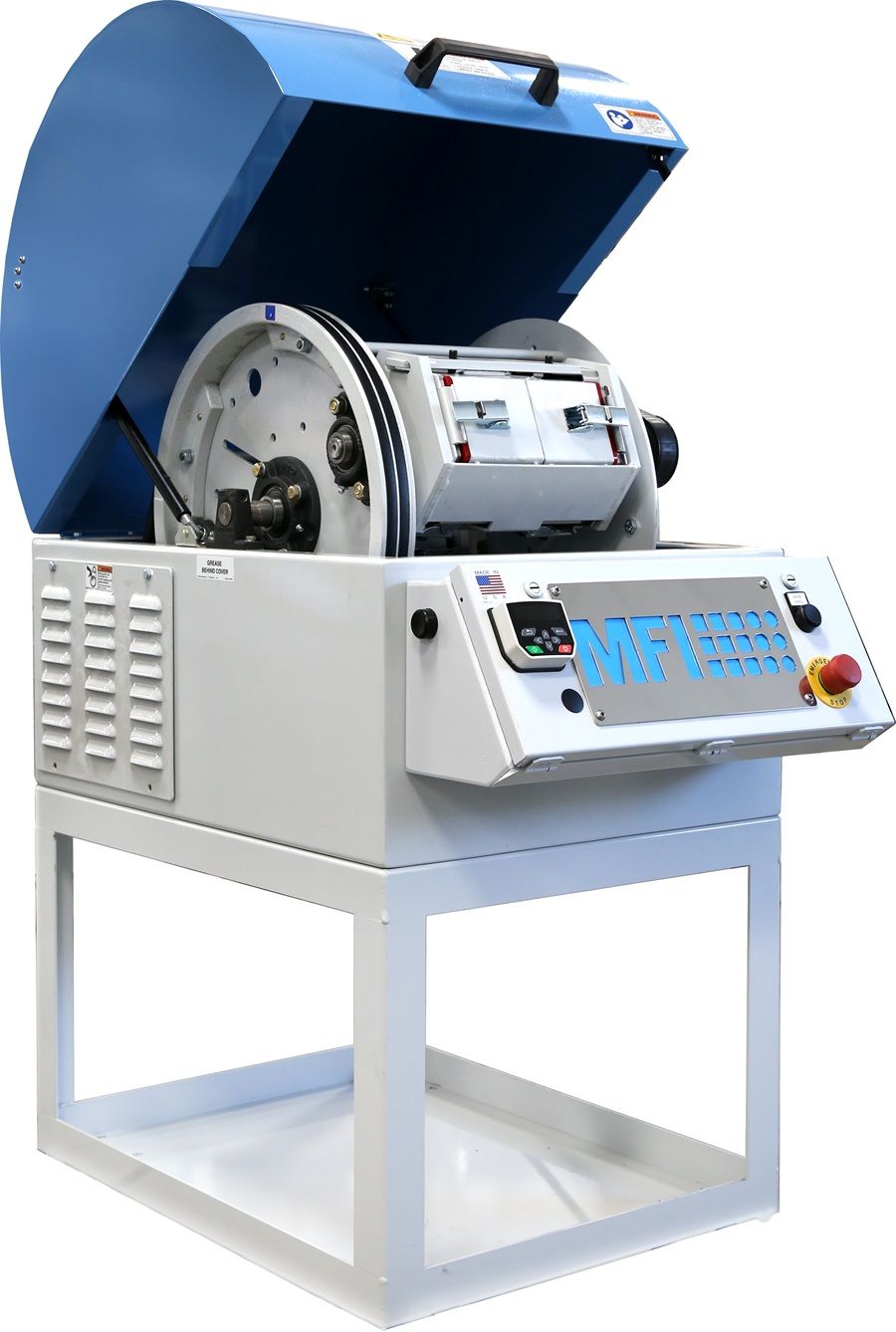
Mass Finishing Inc. (MFI) will unveil its new HZ-6 compact, centrifugal barrel-tumbler finishing machine at the RAPID + TCT 2026 event April 14-16 at the Thomas M. Menino Convention and Exhibition Center in Boston, Massachusetts. At Booth #2033, visitors will learn how this new system reduces labor costs, decreases production times and frees up valuable floorspace. The compact finishing machine removes both surface roughness and scale simultaneously to consistently generate mirror-like finishes on 3D printed metal parts.
MFI described the HZ-6 as the smallest industrial high-energy finishing machine on the market. A footprint of only 3-ft x 2-ft allows the machine to fit into most operations without sacrificing finishing speed or quality. An optional stand with large caster wheels is available and multiple available barrel styles give the machine flexibility to work in most industries.
For the simultaneous finishing of multiple parts, the machine uses the pressure and friction created through centrifugal force to remove excess material and burrs, polish part surfaces and create a uniform finish. MFI said the system is quieter than vibratory tumblers and achieves finishes that are isotropic, meaning parts are polished uniformly and evenly in all directions.
The machine’s barrel tumbler features two cradle positions, a standard full-size latched-end barrel (8.375 inches), and two half-size latched-end barrels (3.625 inches). When using the full-size barrel, the HZ-6 accommodates parts up to 8-inches long and 4.5-inches in outside diameter, while the half-size barrels are suited for processing small, micro-precision parts. The barrels require a small amount of media, which makes for easy iterative testing with different material types and processing diameters.
Centrifugal barrel finishing, also known as centrifugal barrel tumbling, operates on the “Ferris Wheel” principle with a one-to-one ratio of barrel rotation to turret rotation. The process involves loading one or all four chambers with a mixture of parts, water, compound and media, which are filled to 50-80 percent capacity. As the machine rotates, the barrels spin around the turret in a planetary motion, creating a highly effective sliding force inside the barrel.
The machine is suited for common part materials such as titanium, aluminum, Inconel, nitinol, printable plastics, carbon steel, gold and silver. For the best finishing results, it uses ceramic, plastic and porcelain media in a variety of 3D shapes and size variations.