

New Document Addresses the Challenges of EV Drivetrains
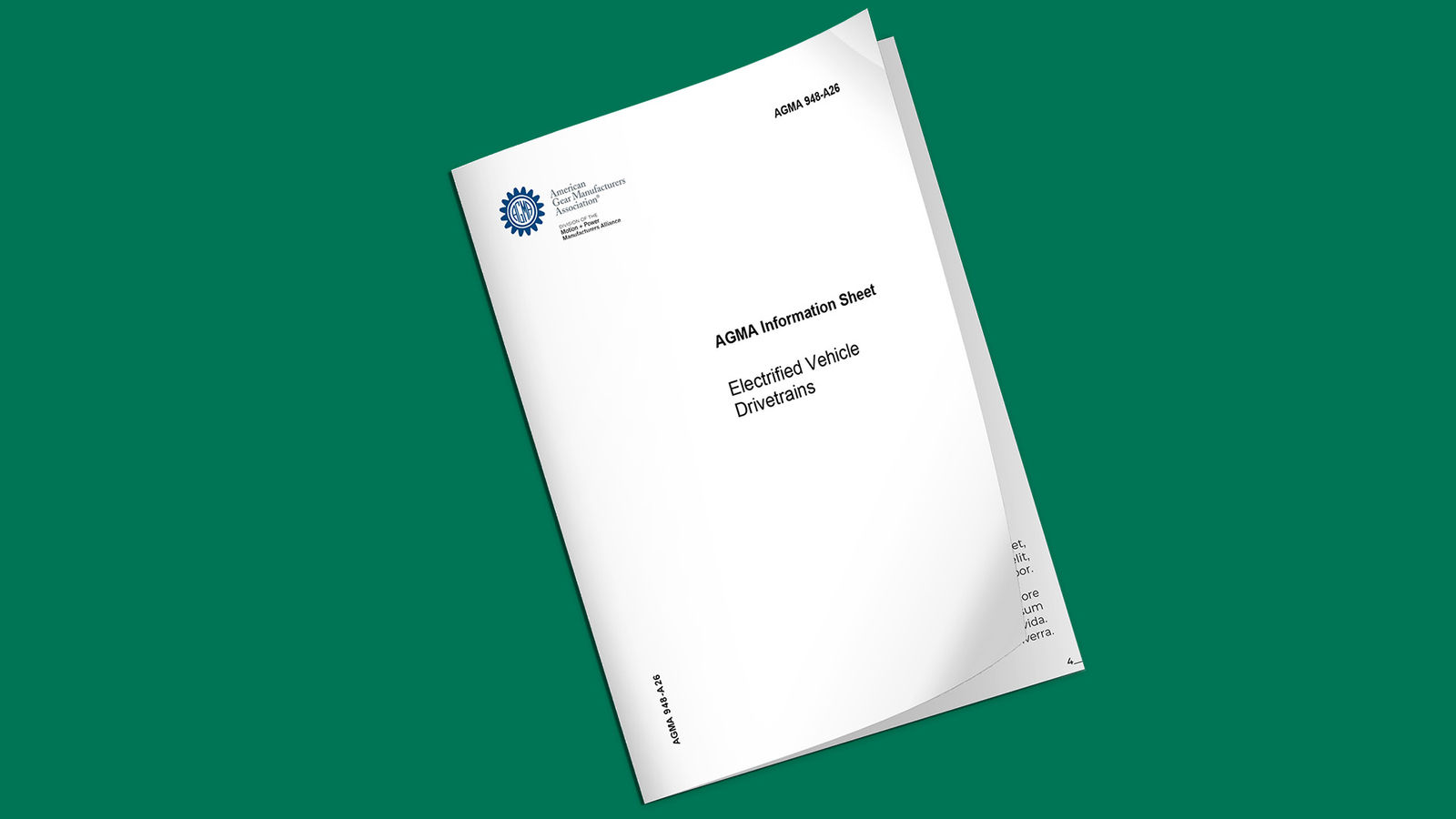
The Motion + Power Manufacturers Alliance (MPMA) has released AGMA 948-A26, Electrified Vehicle Drivetrains, a comprehensive design guidance document for engineers developing geartrains and mechanical systems for hybrid, battery-electric, and plug-in hybrid electric vehicles. Approved by the MPMA Board of Directors on April 23, 2026, it marks a significant milestone as the industry navigates one of the most consequential transitions in vehicle engineering.
Why This Document Was Needed
Electrified powertrains impose fundamentally different requirements on mechanical components. Electric motors operate at higher speeds with sharper torque transients. Regenerative braking introduces bi-directional loading. Near-silent operation raises the bar for NVH performance, as gear whine previously masked by engine noise becomes clearly audible. High-voltage systems also introduce concerns around bearing current damage, electromagnetic compatibility, and lubricant chemistry.
The industry identified this gap in May 2021, when the AGMA Electric Drive Emerging Technology Committee published the white paper A Gearing Centric Snapshot of the EV Space. A working group convened in Detroit in June 2024, and the project was approved by the AGMA Technical Division Executive Committee in October 2024.
What the Document Covers
AGMA 948-A26 addresses design considerations for electrified drivetrains across ground and marine applications, including passenger cars, commercial vehicles, construction and agricultural equipment, mining vehicles, and watercraft. Topics include:
Duty cycle and loading—drive cycle definition, high-cycle survivability, inertial loading, and reverse loading during regenerative braking. Drivetrain configuration—inline, offset, planetary, parallel-axis, overhung, and wheel hub motor architectures, plus housing deflection limits, park lock design, and differential integration. NVH performance—damping strategies, motor excitation, torque ripple, and motor controller feedback. Gear design—electrical harmonics through tooth count selection, high contact ratio gearing, profile and lead modifications, surface finishing, transmission error analysis, and ripple/waviness measurement. Bearings, seals, and lubrication—electrical insulation, shaft current mitigation, high-speed lubrication, viscosity and efficiency trade-offs, and thermal management. Manufacturability and maintenance, including high-voltage safety considerations.
AGMA 948-A26 is available at motionpower.org.
MPMA would like to thank the members of the AGMA 948 Working Group for their valuable work in developing the document and the Gear Applications Committee for overseeing the project.MPMA Gear Applications Committee Chair: William Hankes, Thyssenkrupp Polysius |