



[advertisement]
Feature Articles

July 10, 2026


Aaron Fagan


Features

Skiving’s Motion, Grinding’s Finish

A new process runs skiving kinematics with an abrasive CBN tool, targeting a long-standing gap in internal-gear finishing

Hard finishing, the accuracy-restoring operation that follows heat treatment, is for external gears a crowded field: generating grinding, profile grinding, and gear honing all compete, and the engineer mostly selects among mature options on cost and quality. For internal gears, the choices are far fewer, and they pull in opposite directions. SkiveFinishing, which Liebherr-Verzahntechnik introduced publicly at EMO Hannover in September 2025, is aimed at that shortfall. To understand why it matters, look first at what makes the internal gear the awkward case.

The Dilemma

The difficulty is geometric. An internal gear presents its teeth on the inside of a ring, with concave flank curvature and a bore that limits both the tool’s size and how it can approach. The threaded-wheel generating grinding that dominates external-gear finishing depends on a worm-form wheel that will not fit inside most internal gears, so its productivity is largely unavailable here. What remains divides between hard skiving and profile grinding.

Hard skiving sits on the defined-edge side: gear skiving after hardening, with a pinion-shaped cutter ground to a known geometry. It is fast and reaches inside the ring well, but as a defined-edge process on hardened steel, it meets a quality ceiling. Profile grinding sits on the undefined-edge side: an abrasive wheel reaching into the bore to form-grind each flank. It delivers precision, but the small wheel diameter forced by the bore, plus the form-grinding stroke, makes it slow and costly, justified only where quality demands outweigh cycle time, as in high-volume e-Mobility and commercial-vehicle work.

Hybrid Design

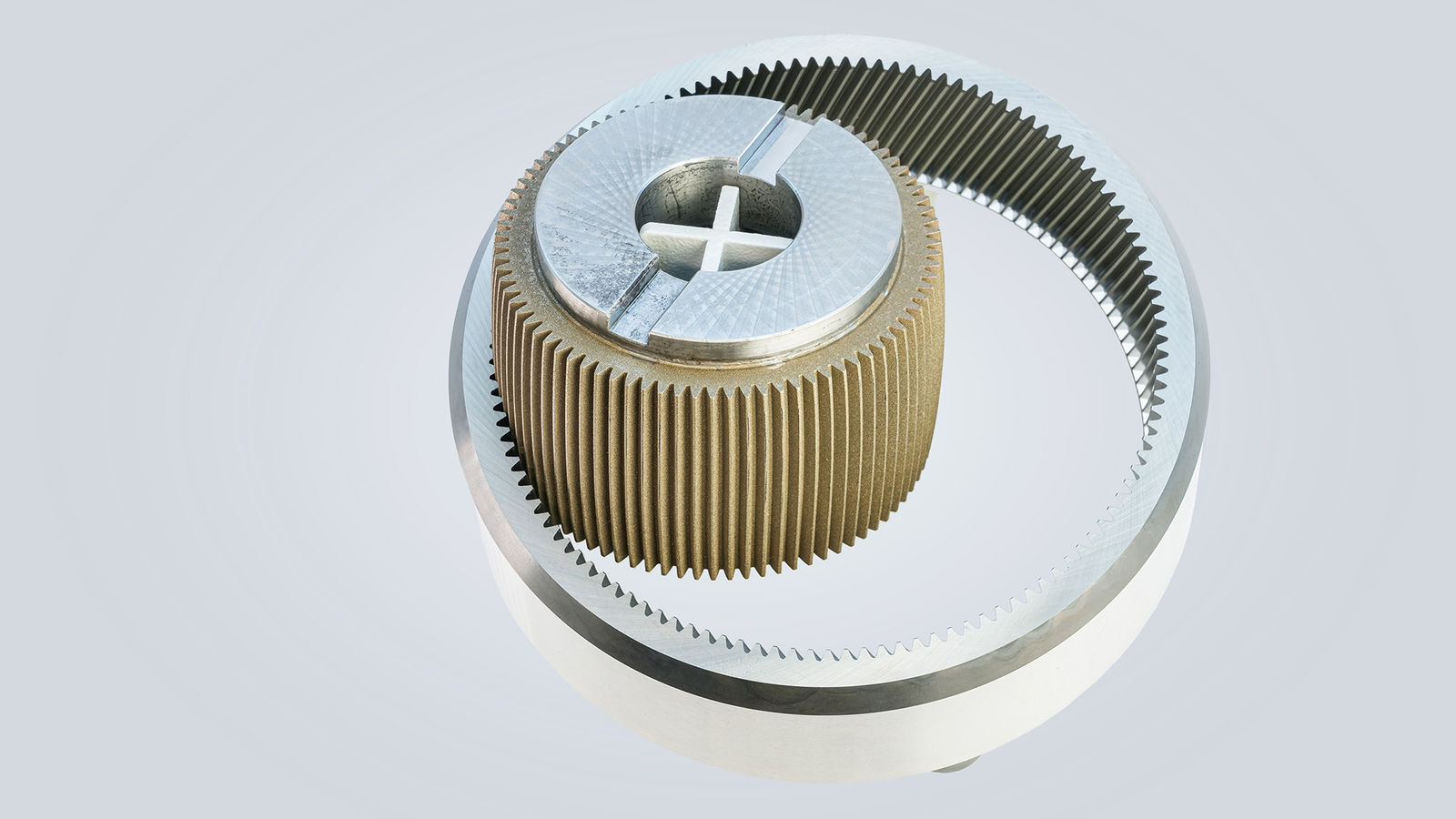
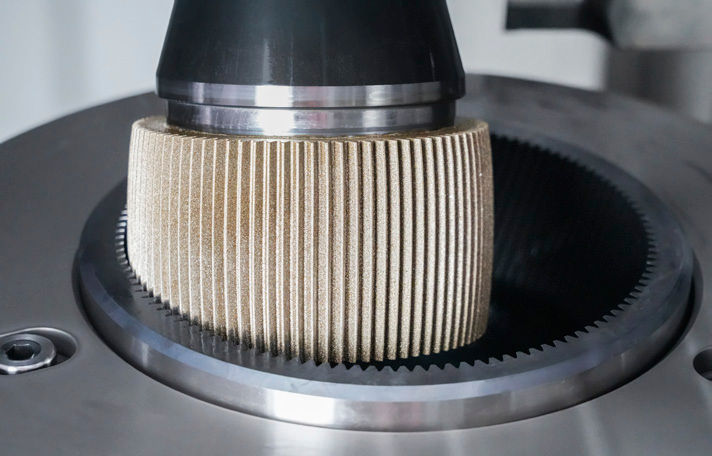
SkiveFinishing runs the kinematics of gear skiving but replaces the defined-edge cutter with an electroplated tool carrying cubic boron nitride (CBN). Material comes off by the microcutting action of abrasive grains, as in grinding.
SkiveFinishing is based on the same kinematics as gear skiving. Non-dressable, electro-plated skiving tool with multiple shift positions. (All images: Liebherr)
SkiveFinishing is based on the same kinematics as gear skiving. Non-dressable, electro-platedskiving tool with multiple shift positions. (All images: Liebherr)

Gear skiving is a continuous generating process: the pinion-type tool and the workpiece rotate in a fixed ratio about axes set at a shaft angle, and the resulting sliding velocity along the tooth does the cutting. The tool feeds axially along the line of contact, removing stock with a single galvanically bonded layer of CBN rather than a sharpened edge. That is the source of the fine surface finish, and the reason for a constraint discussed below.

Why CBN?

Liebherr describes CBN as the second-hardest cutting material after diamond, which invites the question: why not the hardest? The answer is a piece of materials engineering that promotional language tends to skip. Diamond is carbon, and at cutting-zone temperatures, carbon diffuses readily into iron, so a diamond tool wears chemically and fast, on ferrous workpieces, whatever its hardness. CBN is chemically stable against iron and holds its hardness when hot, which is why it, not diamond, is the standard superabrasive for hardened steel. The choice is not a compromise on hardness but the right one for the material.

Share and save:


This article appeared in the July 2026 issue.


Read PDF

[advertisement]

The approach has a longer history than the product. Mehr’s own doctorate concerned hard precision machining of gears by gear shaping with diamond-coated tools. SkiveFinishing can be read as that idea carried to internal gears, trading the reciprocating shaping stroke for skiving’s continuous kinematics.

The Tool

The electroplated CBN tool is non-dressable, and that single fact shapes the process. A grinding wheel can be reprofiled in-house when it loses form; a single plated layer of grit cannot be touched up that way, so when it wears out, the tool goes back to Liebherr’s Ettlingen site to be stripped and re-plated.

The design compensates in two ways. The tool has a crowned form and several shift positions across its width; as one wears, it indexes axially to fresh CBN, much as a hob is shifted along its length. And because that form is fixed, the flank modifications normally dressed into a grinding wheel, such as tip relief, profile crowning, and lead, are built into the tool instead and imparted directly to the part, even on internal gears that would otherwise require profile grinding.

The trade runs both ways. Taking the dressing step out of the cell simplifies operation and suits high volume, but it ties the user to the supplier for re-plating, with the turnaround that implies, and fixes the flank geometry in the tool rather than at the machine. Whether that favors a given shop depends on its parts, its volumes, and how settled its flank specifications are.

Watch the Full Presentation

Dr.-Ing. Andreas Mehr, Head of Technology Development, Liebherr-Verzahntechnik GmbH, lays out SkiveFinishing in greater depth in an on-demand webinar from MPMA’s Emerging Technology series. “SkiveFinishing—Introduction of a New Hard Finishing Process for Internal Gears” walks through the conventional options for hard-finishing internal gears, the process principle, and the machining results cited here, then closes with a side-by-side comparison against hard skiving and CBN profile grinding.

Free with registration at: motionpower.org/skivefinishing-introduction-of-a-new-hard-finishing-process-for-internal-gears-2

Implications

In initial trials on its LK-series skiving machines (designated by workpiece-diameter range, LK 180–280 and LK 300–500), Liebherr reports gear quality within ISO 1328-1 Class 5 and surface roughness of Ra < 0.4 µm, figures Mehr presents in his Emerging Technology webinar (see sidebar). Class 5 places the accuracy in the range more often associated with ground gears than cut ones.

The process is also credited with raising tooth-flank load capacity through higher residual compressive stress. This is plausible: well-controlled CBN machining runs comparatively cool and tends to leave compressive stress, unlike the tensile stress and white-layer risk that accompany grinding burn. A compressive surface benefits bending and contact fatigue, so the claim is reasonable, though, as with the accuracy figures, the data come from Liebherr.

Against its incumbents, the picture is straightforward: higher quality and finish than hard skiving, from the abrasive mechanism and the residual-stress benefit; greater productivity than profile grinding, from the continuous kinematics and the ability to carry modifications in the tool. The applications Liebherr names, aerospace, e-Mobility, and the planetary gearing of trucks and tractors, where less heat-treat distortion allows smaller, lighter gearboxes at equal power, are where that combination pays off.

What Remains

For a process this new, the open questions are the ones any specifying engineer will ask, and public material does not yet answer them: independent quality and surface data; comparative cycle-time and cost-per-part studies against profile grinding on representative parts; and the practical envelope, namely module range, minimum bore and gear size, and how the non-dressable tool performs across a varied part mix.

[advertisement]

None of this detracts from the promise of the idea itself. If the reported quality holds up under independent scrutiny and the economics work at volume, SkiveFinishing closes a gap in internal-gear hard finishing that has been open for a long time. That is reason enough to watch this technology closely and to follow the data.

liebherr.com