The gear industry navigates uncertainty, finds pockets of strength, and bets on automation
Survey Analysis
The Forces at Work
Of the 137 respondents to our annual gear-industry survey, the message was clear: tariffs are the defining challenge of 2026. But the frustration runs deeper than the duties themselves. Manufacturers can absorb cost increases; they can’t absorb chaos. When rules shift weekly and exemptions evaporate overnight, planning becomes guesswork. One respondent captured the exhaustion: “In 2025, they were all over the place, without warning, up and down. Terribly disorganized.”
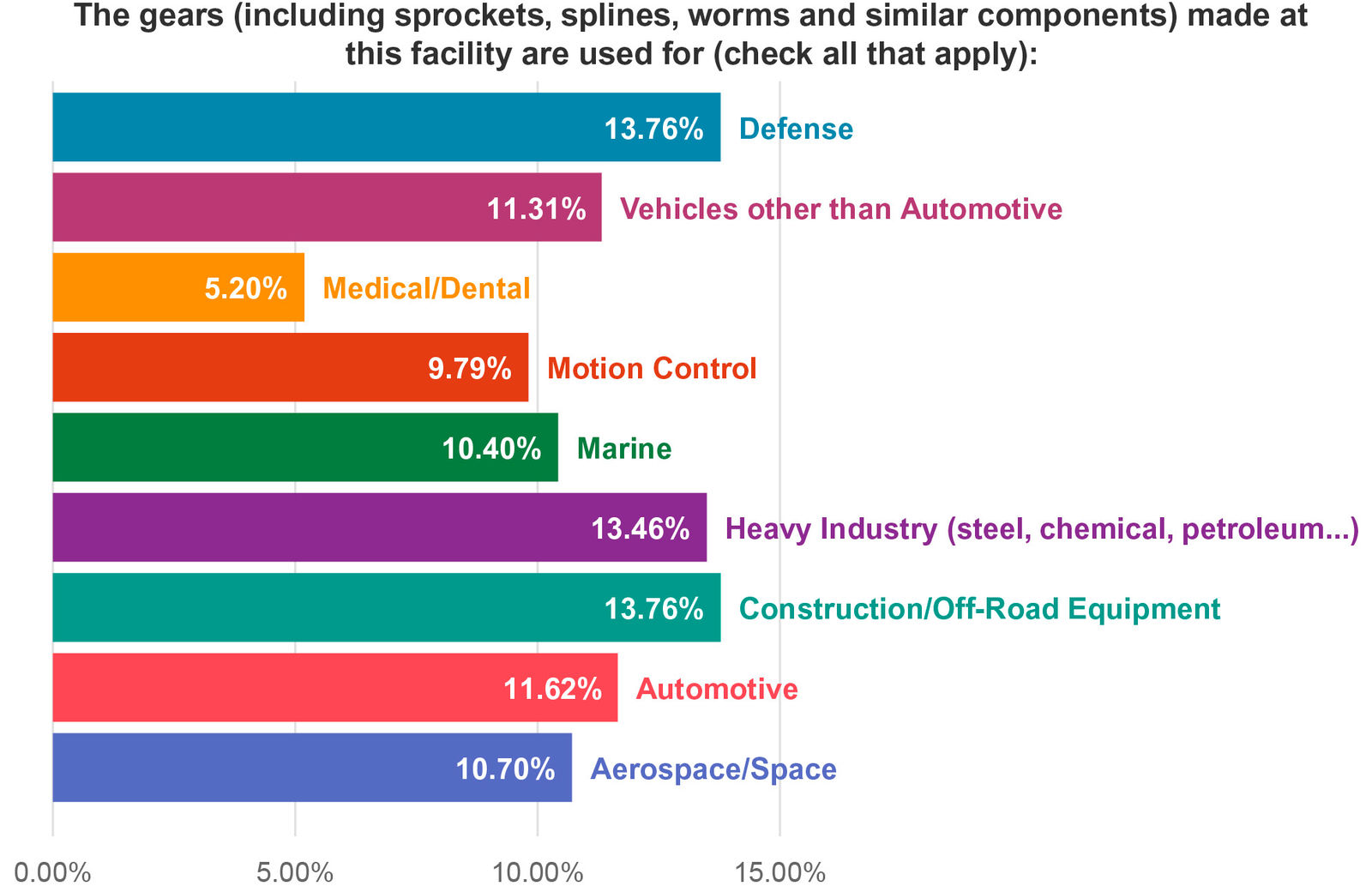
Yet within this turbulence, distinct currents run strong. Defense and aerospace work has surged. Oil and gas, buoyed by loosened regulations, is “very active” according to multiple respondents, with mobile power units and gas compression driving demand. Overhaul and repair business is booming—when new equipment becomes expensive or hard to source, companies keep existing machines running longer, and that means gears.
The electric vehicle transition continues reshaping the landscape, though not uniformly. EVs require fewer gears than internal combustion drivetrains, pressuring some manufacturers while others pivot toward the precision demands of EV gear systems—quieter operation, tighter tolerances, micro-geometry that would have seemed exotic a decade ago. One respondent noted customers now demand “noiseless gears,” a specification that ripples back through design, cutting, and finishing operations.
The skilled labor shortage has calcified into a permanent condition. Respondents don’t speak of it as a problem to solve but as terrain to navigate. Experienced machinists retire; replacements are scarce and take years to develop. “Old time mentality,” one respondent observed, warning that without change, “no young people will be attracted to the industry when given a choice otherwise.”
The Cautious Apprentice
Most gear companies have experimented with artificial intelligence (AI); few have integrated it into core operations. The typical deployment involves marketing copy, meeting transcription, and email drafting—useful but peripheral.
Where companies have pushed further, results vary. One reports that AI-assisted engineering and design is “paying off.” Another uses AI to optimize production scheduling against the competing demands of marketing forecasts, manufacturing capacity, and supply chain constraints. These aren’t trivial applications.
But skepticism persists, and it’s earned. One respondent tried using AI for ratio calculations and watched it fail. Another found AI analysis “often incorrect and inconsistent.” The technology works well enough for tasks where errors are easily caught and corrected; it’s not yet trusted where mistakes are costly.
A deeper concern runs beneath the practical objections. Several respondents worry about feeding proprietary knowledge into systems they don’t control. The gear industry runs on accumulated expertise—decades of understanding how a particular machine behaves, how a specific material cuts, what tolerances a given application actually requires. That knowledge has value precisely because it’s hard-won and closely held. Handing it to an AI feels, to some, like giving away the store.
Still, the trajectory is clear. Companies that dismissed AI entirely a year ago now describe “pilot programs” and “exciting opportunities.” The question isn’t whether AI will reshape the industry, but how quickly and in what form.
Pragmatism Over Poetry
Sustainability in the gear industry tends toward the practical rather than the aspirational. Companies pursue initiatives that reduce costs while meeting regulatory requirements; grand environmental visions are rare. This isn’t cynicism—it’s the reality of an industry operating on thin margins in competitive global markets.
The most common efforts involve recycling and waste reduction: chip briquetting machines that recapture cutting oil, skimmers and filters that extend coolant life, corrugated compactors and pallet chippers that keep material out of landfills. Several companies have installed solar panels. Others have switched to dry cutting where possible, eliminating oil waste entirely. One reports achieving net-zero emissions through recycled groundwater cooling systems.
Energy efficiency drives much of the activity. Newer equipment simply uses less power than what it replaces, and when utility costs rise, the payback calculations sharpen. Digitization helps too—better data means less waste, fewer rejected parts, more efficient scheduling.
But sustainability’s prominence has dimmed. One respondent noted its importance has “changed from high to neutral,” reflecting shifting political winds. Another called it “a dirty word here.” A European manufacturer complained that sustainability bureaucracy has “become a heavy burden, counteracting any gains.”
The most honest assessment came from a respondent who noted that sustainability “has to be economically sustainable in the middle and long term.” That’s not a rejection of environmental responsibility—it’s an acknowledgment that manufacturers can’t pursue goals that bankrupt them. The initiatives that stick are those that make business sense on their own terms.
Automation’s Moment
[advertisement]
Among emerging technologies, robotics and automation command the most immediate attention. The business case has become compelling: labor costs rise, skilled workers remain scarce, and robotic systems have matured enough for practical deployment. Multiple respondents describe active installation of robotic cells and collaborative robots, with more planned.
The applications suit the industry’s characteristics. Gear manufacturing involves repetitive operations requiring consistent precision—exactly what robots do well. Loading and unloading machines, moving parts between operations, even some inspection tasks have proven automatable. One company specifically mentioned Standard Bots cobots as supplementing shop staff. Another noted automation’s role in “reducing direct labor cost per part and improving operator ergonomics.”
Additive manufacturing generates interest but remains largely peripheral. Most companies use 3D printing for fixtures, tooling, and prototypes—valuable applications, but not production parts. Metal additive manufacturing hasn’t yet achieved the material properties, surface finish, or cost structure that gear applications demand. “Still waiting for additive metal to be comparable to standard metals,” one respondent summarized. The technology is watched, not adopted.
Industrial IoT deployment varies by company size and sophistication. Larger operations have integrated condition monitoring, predictive maintenance, and production tracking. Smaller shops often haven’t started—the investment is harder to justify when production runs are short, and product mix changes constantly. But the direction is clear; one respondent described plans to use IIoT and AI together “to find machine and process trends.”
A potentially significant market emerged in multiple responses: humanoid robotics. Smart gearboxes for robotic applications represent genuine new demand, distinct from automotive or industrial markets. As one respondent noted, these applications require innovative manufacturing solutions—an opportunity for companies positioned to provide them.
Fewer Players, Higher Stakes
The gear industry continues consolidating, reshaping relationships that in some cases span decades. Private equity involvement has accelerated the process, bringing capital but also, some respondents note, eroding the personal relationships that characterized the industry.
The effects ripple outward in multiple directions. Fewer competitors mean opportunities for survivors—when merged entities discontinue low-volume products or exit certain markets, nimble companies fill the gaps. But fewer suppliers mean reduced options and increased vulnerability. One respondent described supply chain consolidation as having “wreaked havoc” on component sourcing. Another noted that remaining suppliers “do not manufacture or carry the range of products that they used to.”
Customer concentration creates its own pressures. When major accounts merge, their combined purchasing power increases while the supplier’s negotiating position weakens. Lost accounts can’t easily be replaced when fewer potential customers exist.
The outlook divides along size lines. Larger companies see consolidation as opportunity—acquisitions that expand capability and market reach, competitors absorbed or weakened. Smaller companies feel the squeeze intensifying. “Only the largest companies will remain,” one respondent predicted. “There is no room even for medium-sized ones.”
Whether that proves true depends on factors beyond any single company’s control. But the trend line points toward an industry with fewer, larger players—and the consequences for innovation, regional manufacturing capacity, and customer service remain to be seen.
Perspectives from Machine Tool Makers
The survey paints in broad strokes. To understand the finer grain—where the debates lie, where the opportunities hide—we turned to executives at eight gear machine tool companies: Gleason, GMTA, Helios Gear Products, Kapp Niles, Klingelnberg, Liebherr, Machine Tool Builders, and Nidec Machine Tool America.
The Weight of Uncertainty
Prasad Kizhakel, chief sales officer of the Klingelnberg Group, frames the current moment starkly: “The current environment rewards ‘preservation’ over ‘growth and innovation.’” When visibility disappears, so does the appetite for the capital investments that drive both equipment sales and the R&D that produces better machines.
John Perrotti, chairman and CEO of Gleason Corporation, observes that geopolitical tensions are “causing our global customers to pause/slow investment.” Felix Scholz, managing director of Liebherr Gear and Automation Technologies, notes that reshoring momentum remains strong, but companies are delaying purchases “because they’re waiting for clarity on tariffs and industrial policy.”
Shane Hollingsworth, vice president of sales at Kapp Niles, saw the effect in real time: “We had strong bookings each month until the tariff announcements. It was a very clear impact to our business and activity.” When the EU-U.S. trade agreement was announced in August, opportunities began increasing again—evidence that clarity, even imperfect clarity, unlocks decisions that uncertainty freezes.
For distributors of imported equipment, the math is particularly punishing. Claudia Hambleton, corporate treasurer at GMTA, points out a common misconception: “Many believe foreign exporters are paying for these tariffs, but in our case, these tariffs are being paid for by the importer as we try to supply and service U.S. manufacturers.”
Nidec Machine Tool America offers a different angle. Now that tariffs have largely stabilized, says the company, “the real hurdle is the cost of money.” High interest rates hit hardest where it matters most—the small and medium-sized shops that form the industry’s backbone.
The result: elongated sales cycles and last-minute decisions. Ross Wegryn-Jones, director of sales and marketing at Machine Tool Builders, describes customers as a “fickle mistress”—delays and holds on purchase orders have become routine. Nidec reports that orders now arrive “down to the wire,” compressing not just shipping timelines but the process development and testing that complex gear work requires.
Sidebar: Navigating Challenges and Opportunities in Gear Manufacturing
A conversation with Kika Young, president, Forest City Gear
Matthew Jaster, Director, Editorial Content
Kika Young
My recent discussion with Kika Young, president, Forest City Gear, took place in January 2026 to discuss the state of the gear industry. Key talking points included the current skilled labor shortage, lead times, general volatility, AI, smart manufacturing tools and the future of gear innovation.
Skilled Workforce—Perception vs. Reality
Our first topic of conversation addressed the skilled labor gap, a topic regularly appearing in B2B and trade publications involved in both manufacturing and engineering. Today, finding and retaining the right talent with the necessary skillsets remains a challenge.
“Finding and retaining the right talent is still a challenge—not only from a technical standpoint, but in finding people who want to come in every day and work in a factory or machine shop. For a variety of social and cultural reasons, accelerated by COVID, fewer employees are interested in a traditional nine-to-five job. Many are drawn to remote or independent work and greater flexibility.”
If it wasn’t challenging enough to convince middle-school and high-school students to consider manufacturing as a career, it’s become increasingly difficult to convince their parents.
“There remains this kind of negative attitude towards manufacturing across the board. We spend a lot of time talking to local high schools. We even try to get into the middle school level. And honestly, the kids are interested. They think we’re making cool stuff. What we’re fighting against now is the presumptions of their parents. ‘You don’t want to work in a shop,’ You don’t want a career in manufacturing.’ So, we must convince the students and their parents on the lasting benefits of getting into the skilled trades,” Young said.
Lead Times and General Volatility
According to Young, lead times on special materials is another 2026 challenge.
“Usually due to geopolitical reasons, some specialty materials—needed for defense and aerospace work—tend to lag and can’t meet the expectations of customers. Balancing these expectations becomes a huge topic of conversation,” Young said. “We live in this immediacy culture, right, and we sometimes need to explain the differences in producing say a prototype gear on a 3D-printer versus a cut gear. Every project is a little different.”
Cost pressure remains a key challenge in 2026.
“This is always an issue. There’s been a huge increase in labor costs. I think the wage rates in the labor market have been lagging for such a long time and they’re finally catching up. This is fantastic, but there are other pieces of inflation—post COVID—that are kind of offsetting that,” Young said.
It becomes a careful, strategic dance to manage costs and lead times. The key is the manufacturer’s ability to pass along reasonable customer increases to the customers. This becomes a priority.
“These are conversations we’re having all the time,” Young noted.
AI and Digital Manufacturing
Forest City Gear prides itself on being at the forefront of manufacturing technology. The company is expanding its AI toolkit to enhance shop floor operations.
“Our ERP system has a lot of information but has limited reporting capability. We have a super sharp young man here at FCG who is utilizing AI to pull reports and documentation that used to be very burdensome to track in Excel,” Young said. “Our big goal for 2026 is to leverage AI for our hob and shaper cutter inventory. We have a huge number of hobs and shaper cutters in stock. We sharpen a lot of these in house, but the inventory is in this spreadsheet that has existed since DOS.”
With all the available information on tool life, tool wear and additional specifications, FCG is hoping to create an interactive inventory using AI resources.
“We’re extremely excited about this specific project and in doing so hope to learn other ways to leverage AI tools across the shop floor in the future,” Young said.
Future Considerations
Young said she is all-in on the possibilities of AI in manufacturing moving forward. “It’s going to be a focal point across all of manufacturing, really across every sector at this point, right? We’ll navigate where it makes sense to employ these tools on the floor and figure out where it probably won’t. Personally, I’m excited to see such rapid change taking place in gear manufacturing in the next five to ten years through AI deployment.”
One area Young will approach with caution is compliance.
“We can take a part that’s designed for a refrigerator in my kitchen and plug and play that into AI. But I can’t do that for a lot of the parts currently in gear manufacturing. So, getting platforms that are truly compatible with Cybersecurity Maturity Model Certification (CMMC) or even NIST 800-171 is going to be critical to deploy AI tools.”
Another area to keep an eye on is mergers and acquisitions. Young knows of at least two players in the industry who are extremely active in acquiring gear companies.
“The face of gear manufacturing is constantly changing. I wouldn’t be at surprised to see some additional mergers in the future,” Young added.
Lastly, Young believes workforce development in manufacturing is going to change drastically in the coming years.
“The jobs where you might see a significant number of reductions due to AI will be white collar jobs. There will be a huge shift in the dynamics between white- and blue-collar workers. We’ll see a positive push for sheet metal workers, electricians, plumbers, welders, etc. All these classic skilled trade positions will be sought after, and that’s extremely exciting,” Young said.
Despite the headwinds, certain markets continue pulling investment. Aerospace and defense remain robust. Energy markets—particularly oil and gas—show strength. And a newer category has captured attention.
Adam Gimpert, president of Helios Gear Products, identifies consumer robotics as “the biggest game-changer on the horizon.” This isn’t speculation about distant possibilities; it’s emerging demand requiring smaller, highly automated gear solutions at scale. Gleason similarly cites robotics among the markets showing relative strength.
Regionally, Asia continues to dominate. Klingelnberg reports that the biggest pull for bevel gear equipment, cylindrical gear grinding machines, and high-end metrology “continues to originate in Asia”—China, India, Japan, and Korea leading. This pattern has held for five years and shows no sign of shifting.
On the process side, hobbing remains “the bread and butter of the industry,” as Nidec puts it, because nothing matches its speed and cost per part. But finishing and inspection are gaining ground. Quality demands keep climbing, and shops increasingly recognize they can’t just cut gears fast—they have to prove they’re perfect.
The Electrification Question
The EV narrative has splintered along regional lines. In China, electrification for passenger cars and light commercial vehicles has reached what Klingelnberg describes as “maturity”—still growing, but at a sustainable pace rather than the frenetic expansion of recent years.
North America tells a different story. Nidec reports that “the full-EV rush has largely disappeared,” with hybrids taking the lead as the practical choice for anyone outside major cities. GMTA sees “a reversal narrative.” Helios notes that EV programs continue but timelines have stretched.
Perhaps more consequential than the policy shifts: the capacity question. Hollingsworth notes that electrification drove “many new projects post-COVID,” but warns that “the volumes are not materializing as expected.” Plants built for an EV surge that hasn’t arrived may stall further capacity investment—or see resources reallocated entirely.
Europe occupies a middle ground—electrification proceeding, but on “slow burn,” as Klingelnberg characterizes it.
For gear manufacturers, the message is clear: flexibility matters more than ever. The companies that bet everything on EV gearing may find themselves exposed; those maintaining capability across propulsion types are better positioned for however the market evolves. Micro-mobility presents its own opportunity—Klingelnberg expects that market to double by 2030, driven primarily by Europe and Asia.
AI and Digital Tools
Where survey respondents offered general skepticism about AI, machine tool makers reveal a wider spectrum. Klingelnberg represents the advanced end, with Daniel Meuris, head of digitalization and virtualization, describing deployment of “big data analytics extending to machine learning technologies and LLM agents,” integrated into both internal processes and customer-facing products.
Most companies occupy more modest territory. Helios uses AI for communications support. Machine Tool Builders employs it for contracts, text editing, and reducing reporting burdens. Wegryn-Jones offers a characteristically grounded assessment: “All that AI is actually doing is duplicating what a stenographer would have done in 1960 or a copy editor in 1970 or perhaps an intern in 1980.” That said, he acknowledges its spreadsheet capabilities are “remarkable, useful, and do save some significant amounts of time.”
Which digital initiatives have delivered real returns? Gleason reports that closed-loop corrections and optimizations are “proven value adders,” and its Fingerprint status monitoring solutions provide genuine value for predictive maintenance. Klingelnberg’s Meuris observes an inverse relationship between complexity and clear ROI: simple connectivity technologies like MQTT or OPC UA deliver immediate value, while larger initiatives require longer horizons.
Hollingsworth sees condition monitoring as the clearest opportunity: “If you can plan your downtime, you reduce your downtime.” The value proposition is straightforward—a moderate investment upfront against reduced unplanned stoppages.
Beyond analytics, Hollingsworth points to a quieter revolution: software has become “an equivalent IP aspect to machines as compared to the inherent mechanical design.” The capabilities unlocked through software development, often on essentially unchanged hardware, now matter as much as the iron itself.
Helios offers a contrarian view on IIoT: it “had its moment,” but tariff disruptions and industry uncertainty pushed those projects aside. AI has taken center stage because it delivers immediate, visible value. IIoT will return, but for now it’s waiting in the wings.
The Workforce Puzzle
Companies are responding to the experience gap on multiple fronts. Klingelnberg has implemented dynamic digital manuals for manufacturing and assembly that incorporate operator feedback, preserving process knowledge in accessible form. The company’s grinding assistant software embeds expert knowledge directly into the operator interface, supporting less experienced workers in setting up effective processes.
Liebherr has expanded remote support capabilities and developed modern training simulators. Helios maintains a pipeline through partnerships with local universities and technical schools, offering internships and part-time positions while documenting processes in digital formats that accelerate onboarding.
Nidec takes a different approach: making machines themselves more intuitive. “If we can bake the expertise of a 30-year veteran directly into the software and the user interface,” the company explains, “it makes the learning curve much more manageable for the next generation entering the trade.”
GMTA’s Hambleton sees reasons for optimism: “It is exciting to see more companies take the initiative and offer training, apprenticeship, and mentorship programs. Young people need other options to a four-year university degree.”
Hollingsworth frames the challenge more bluntly. Germany’s apprenticeship programs start young adults early in machine tool careers, but the deeper problem is cultural: “For many years manufacturing was given a negative connotation and tech was the ‘pushed’ career path in schools. We need to change the culture and perception in North America that manufacturing offers rewarding and successful career options.” Training systems exist; the pipeline of people entering them does not.
Gleason’s Perrotti connects workforce to strategy. When asked about reshoring, he redirects to what he sees as the prerequisite: “First you need a large enough, trained workforce. This needs to be the top priority to expand the industrial base.”
Reshoring: Reality or Rhetoric?
On whether reshoring has translated into actual demand, opinions diverge. Klingelnberg’s Fabian Wolf, CEO of the company’s American operation, reports that reshoring “is translating into tangible demand in the United States, extending from component production through to the machine tool sector.” But he qualifies this: the impact on specialized gear machine tools specifically has been limited, since relatively few gear manufacturers operate in the U.S.
Liebherr sees reshoring boosting overall machine tool demand without necessarily driving purchases of domestically built gear equipment. What is increasing: demand for localized support, service, and integration.
Machine Tool Builders’ Wegryn-Jones says that while they “keep hearing about how reshoring is supposed to enhance domestic demand,” it’s difficult to trace any particular order to that cause. From his vantage point, “it’s just strategic discussion.” GMTA echoes this: “Demand has always been there, but the supply has not. A shift in global production takes a lot of time.”
Hollingsworth is more direct: “No, I don’t see that the tariffs will change where the machines are built, at least for the North America market.” If anything, the pull is in the other direction—Asia has been the largest consumer of machine tools for a decade, and builders may expand their footprint there to serve that volume.
Nidec frames the gap between aspiration and reality in economic terms: “Most companies value domestic production, but they aren’t always in a position to pay a premium for it if the numbers do not align with their budget.”
Competitive Imperatives
Machine tool design has evolved to address the workforce challenge directly. Automation-friendly configurations, tool changers, automatic closed-loop corrections—features that help customers operate effectively with less experienced staff, particularly on night shifts—have become priorities. Connectivity has moved from optional to essential.
Gleason’s Perrotti notes a shift toward systems thinking: “We are now designing more with a systems mindset, not just a single machine or tool.” Liebherr cites real-time monitoring and adaptive control as becoming core features. Machine Tool Builders reports strong customer interest in converting older manually operated machines to CNC operation.
Asked what gear manufacturers must understand to remain competitive over the next five years, the responses converge on continuous investment. Nidec puts it directly: “If you wait until you’re forced to upgrade, you’ve already lost. The shops that will be here in five years are the ones that treat technology as a tool for growth, not just an expense to be avoided.”
Liebherr’s Scholz argues that automation and Industry 4.0 “are no longer optional.” Gleason emphasizes “investing in automated, intelligent systems with a strong partner to support your business.”
Hollingsworth takes the long view: “Global competition, regardless of the tariff topic, is not going away and will continue to increase. We must continue to find opportunities to differentiate ourselves to be a world leader in gear manufacturing.”
Wegryn-Jones offers counsel rooted in an older tradition: “Know thy market, know thy product, know thy capabilities, and don’t take your hand off the tiller. And don’t forget how to have a real conversation.”
In an industry where tolerances are measured in microns and relationships in decades, both the technology and the wisdom matter.