



Unique Pathways to Learning
GROB successfully implements European workforce development strategies in the United States
The disparities between workforce development in Europe and the United States are pronounced. For instance, apprenticeship programs in Europe commence at a significantly younger age and present a wider array of opportunities. While North American initiatives emphasize extensive cross-training in mechanical and electrical disciplines, the European approach delineates specific departmental and positional pathways much earlier in employees' careers. The challenge of training workers swiftly and effectively has long been a concern for manufacturing firms.
GROB has been at the forefront of manufacturing systems and machine tool development since 1926 in Munich. The company has production facilities in Germany, Brazil, China, the United States, Italy, and India, along with global service centers and sales subsidiaries.

In 2023, GROB Systems, Inc. commenced construction on a 135,000 sq. ft. U.S. expansion project. This addition augments the original 400,000 sq. ft. production and shipping space by approximately 35 percent (see photo above) and created approximately 200 new jobs at its U.S. headquarters and manufacturing site in Bluffton, OH. Celebrating a 34-year presence in North America, the expanded area accommodates several of GROB's sub-assembly departments to enhance final production processes at the main facility.
Recently, Gear Technology engaged in a discussion about GROB's workforce development strategies in the United States with Thomas Neubert, chief sales officer of GROB Systems Inc. in Bluffton, OH. Like many international manufacturing companies, GROB has adapted several successful European programs for implementation in the U.S.
A Clearer Path Toward Skill Development
To retain skilled and qualified workers, GROB has identified several key focus areas. Neubert emphasized the importance of initiating conversations about growth opportunities and career pathways early in the employment process. “We need to support employees in pursuing further education, starting with competitive benefits—such as fully covered health insurance premiums and complimentary meals—while also fostering engagement through initiatives including holiday celebrations, company sports leagues, and organized running or cycling groups.”
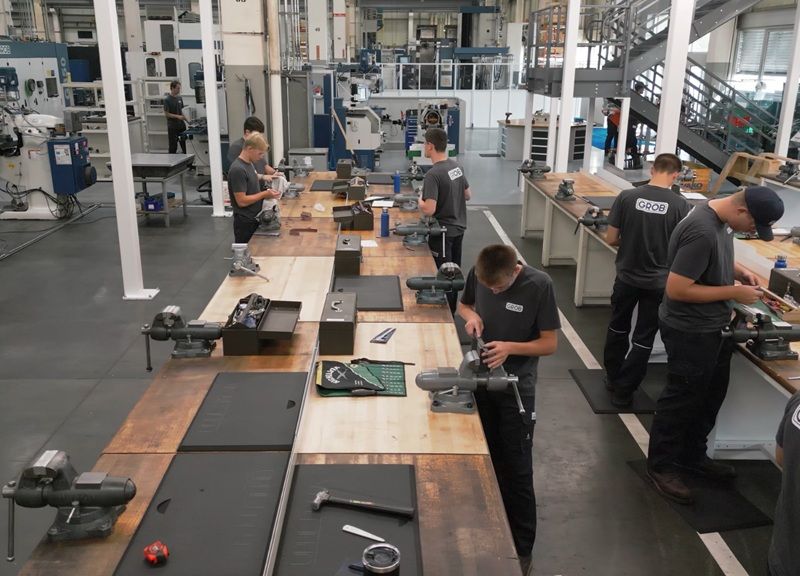
Neubert also highlighted the significance of being receptive to employee feedback. GROB's U.S. apprenticeship program, which mirrors the model used in Germany, has successfully integrated over 600 apprentices since its inception in 1990.
Another significant advancement has been in the implementation of an online learning management system. “Our headquarters in Germany began offering online training years ago, and we have recently developed our own library of courses. This format allows employees to access training on-demand and at their own pace,” Neubert stated.
Currently, GROB’s apprenticeship program combines paid, hands-on training with classroom instruction, mentorship on the shop floor, and exposure to various career paths. Apprentices receive a fully sponsored associate’s degree in electro-mechanical engineering technology from Rhodes State College of Lima, OH, along with a state-recognized journey person certification. The program has transitioned from offering strictly mechanical or electrical degrees to a comprehensive electro-mechanical degree that equips apprentices with a broader skill set, enabling them to adapt to diverse roles as needs arise.
“Our program has expanded dramatically over the past decade, growing from 10 apprentices in 2015 to 60 in 2025. This nearly 20 percent year-over-year growth rate over the last five years reflects both the increasing demand for skilled trades and our commitment to nurturing talent from within GROB,” Neubert explained.
In their second year, apprentices receive mentorship from shop floor technicians during departmental rotations. By their third year, they are placed in a specific department for specialized training, continuing to learn from seasoned technicians who provide invaluable insights and training.
Additionally, GROB has established a dedicated Learning and Development department focused on creating training initiatives for its workforce. “Our GROB Academy program, available to employees from their first day until retirement, provides various pathways for both technical and professional development. Collaboration across departments allows us to develop training that employees can choose or that management can assign,” Neubert added.
The GROB Academy currently offers 143 online courses accessible on-demand. As of July 2025, 646 employees have completed 3,600 courses, dedicating 1,750 hours to learning since the online program's launch in April 2024. Moreover, 189 employees have attended in-person professional development workshops offered within the company in 2025.
“Our product lineup is continuously evolving, necessitating ongoing learning in advanced manufacturing processes. The CEO also hosts company meetings to educate employees about our product lines, current projects, and manufacturing trends. With our learning management system, we will keep developing training for new technologies as they emerge,” Neubert noted. “We also leverage Articulate 360, a suite of online tools for creating interactive e-learning content, which includes a learning management system that hosts, delivers, tracks, and reports on employee training. Feedback surveys help us assess training needs.”

A Productive Workplace
Critical thinking, problem-solving, and communication are essential for cultivating a collaborative and productive workplace. Neubert pointed out that proactive critical thinking is crucial, emphasizing that training employees to anticipate potential issues rather than merely reacting to them enhances productivity and efficiency.
Regular communication regarding employee expectations is vital to ensure that meeting these expectations is a reasonable challenge rather than a guessing game. Discussions around expectations can encourage dialogue, allowing employees to contribute suggestions for improving processes.
Furthermore, the strategic use of automation and robotics can positively influence workforce development. “Manufacturing companies nationwide, regardless of size, are facing challenges in sourcing candidates to meet their hiring needs. It's common to see ‘Now Hiring’ banners displayed prominently. By incorporating automation and robotics, we can reduce repetitive manual tasks, thereby requiring less manpower and allowing employees to concentrate on more technical responsibilities,” Neubert elaborated.
Eliminating repetitive tasks creates a demand for new skills, such as data analysis, allowing GROB to focus on upskilling its workforce. “This enables employees to adapt to new technologies and advance to higher-value roles, ultimately enhancing job satisfaction and engagement,” Neubert added.